A custom home in Texas typically costs $200–$450 per square foot of air-conditioned space to build in 2026, and $350–$600 or more for a luxury custom home, not counting the land. The spread comes from the site, the shape of the house, the finish level, and what each builder counts in the number.
Key takeaways
- 2026 planning ranges for construction only: $200–$450 per square foot for a custom home in Texas, and $350–$600 or more for a luxury custom home. Land is extra.
- A cost per square foot only compares between builders when both divide the same scope of work by the same area.
- Shape, glass, structure and finish level move the budget more than size. Interior finishes are the largest single share of construction cost.
- Site work, soft costs and contingency sit outside most per-square-foot quotes. Plan 5–15% for site work on a subdivision lot, 10–20% of the total budget for soft costs, and 5–10% contingency.
- Austin and Hill Country sites usually price above Houston and San Antonio, mostly because of rock, slope, utilities and local rules rather than the house itself.
What a custom home costs in Texas
How much does it cost to build a custom home in Houston?
A custom home in Greater Houston typically costs $225–$400 per square foot to build in 2026, and $350–$550 or more at a luxury finish level, before land. On a 4,000 square foot house that is roughly $900,000–$1.6 million for construction. The low end assumes a simple shape on a flat lot; the high end reflects more glass, complex roofs, custom cabinetry and stone. These are planning ranges, not quotes; pricing moves with labor, materials and interest rates. Design fees are separate and covered in our custom home design cost guide.
What is a realistic cost per square foot for a luxury custom home?
A realistic 2026 planning range for a luxury custom home in Texas is $350–$600 per square foot, with the most detailed houses running higher. For context, NAHB's analysis of Census Bureau data puts the 2024 median contract price for all custom homes at $166 per square foot nationally and $138 in the region that includes Texas. That median covers every house built on an owner's land, including modest ones, and it leaves out the lot. A luxury home lands at 2–4 times the median because of what goes into it: taller ceilings, more glass, steel for long spans, custom millwork and natural stone. The Census Bureau publishes the underlying figures in its Characteristics of New Housing tables.
Why the numbers never match
Why do cost-per-square-foot numbers vary so much between builders?
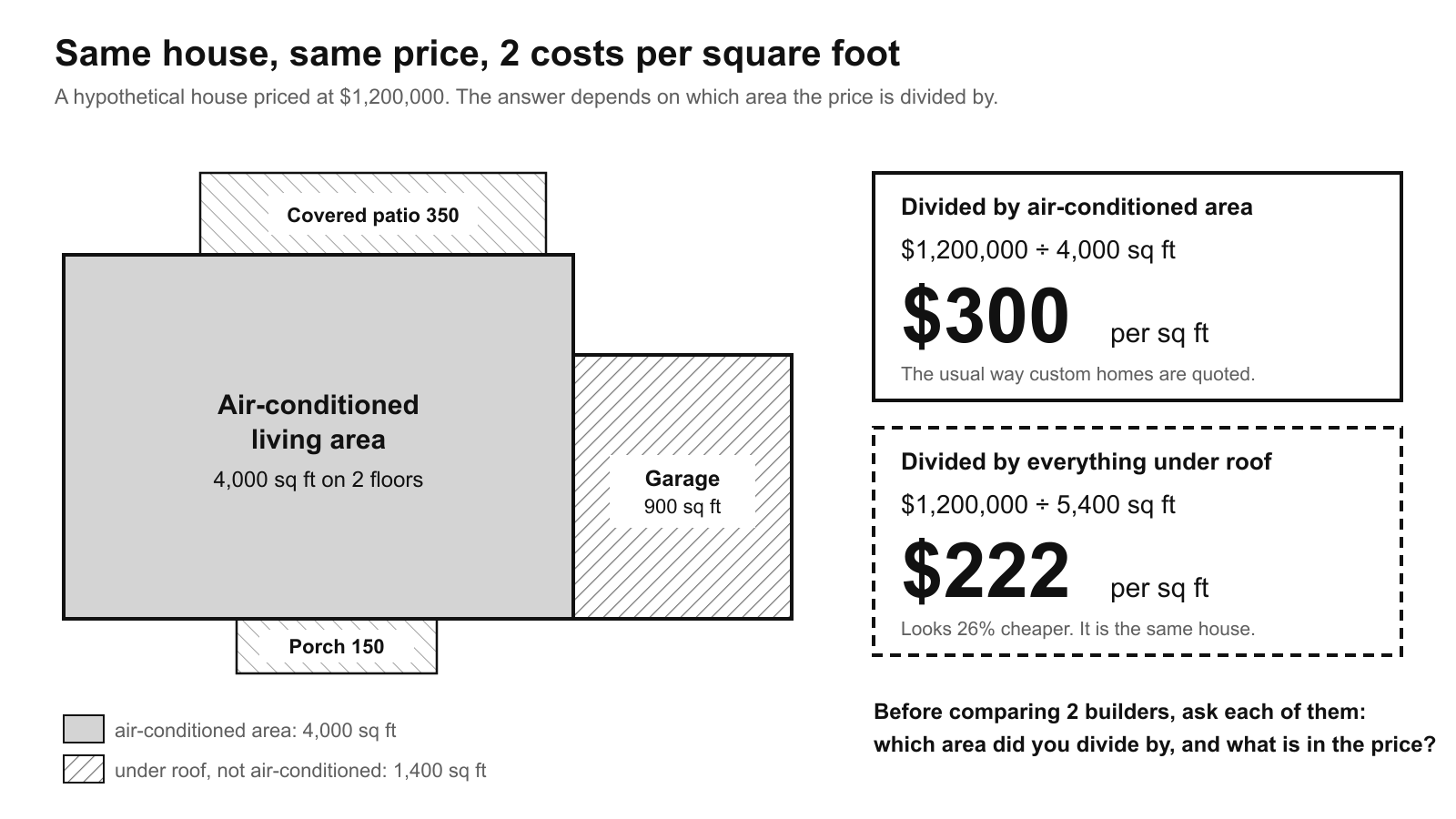
Cost-per-square-foot numbers vary because builders divide different totals by different areas. The same $1,200,000 house is $300 per square foot when divided by 4,000 square feet of air-conditioned space, and $222 when divided by 5,400 square feet under roof, which adds the garage, porches and covered patio. Builders also differ in what the total includes: some carry site work, appliances and landscaping, and others leave them out or cover them with low placeholder amounts. Ask every builder which area was used and what the price covers.

What is included and excluded from a cost-per-square-foot figure?
A cost-per-square-foot figure usually includes the house itself, from foundation to final paint, plus the builder's overhead and profit, and usually excludes the land and most costs outside the walls. Typical exclusions are the lot, design and engineering fees, surveys and soil reports, permit and utility connection fees, long driveways, pools, fences, landscaping, window coverings and furniture. The Census figures above work the same way: the contract price leaves out the lot, and the area counts finished space only, not garages or porches. The grey zone is site work, appliances and outdoor living areas, which some builders include and others do not.
What drives the budget
Which design decisions move the budget the most?
The design decisions that move the budget most are the shape of the house, the amount and size of glass, the structure needed to hold it up, and the finish level. Every extra corner and roof valley adds framing, roofing and labor. Large sliding doors and tall windows cost several times more per square foot than the wall they replace, and long open spans can require steel. Finishes matter most of all: in NAHB's 2024 cost survey, interior finishes were 24.1% of construction cost and plumbing, electrical and heating and cooling rough-ins were 19.2%, ahead of framing at 16.6%. Our guide on where to splurge and where to save shows how to steer those choices.

Does a bigger house always cost less per square foot?
No. A bigger house often costs less per square foot, but only when the extra area is simple space. Kitchens, bathrooms, the heating and cooling equipment and the utility connections cost about the same whether the house is 3,000 or 5,000 square feet, so adding bedrooms and living area spreads those fixed costs and lowers the average. The effect reverses when the added area is expensive: a second kitchen, more bathrooms, taller ceilings, a larger roof and foundation on a 1-storey plan, or long spans that need steel. Stacking area on a second floor is usually cheaper per square foot than spreading it out, as our 1-storey versus 2-storey guide explains.
The costs outside the house
How much should I set aside for site work, utilities and drainage?
Set aside 5–15% of the construction cost for site work on a platted subdivision lot, and $75,000–$250,000 or more on acreage, as 2026 planning ranges. On a subdivision lot that covers clearing, fill, grading, drainage, the driveway and utility connections. Acreage adds a long driveway, a water well, a septic system and a power line to the house. Flood rules can add to it: the City of Houston requires new structures in its regulated floodplain to sit at least 2 feet above the 500-year flood elevation, which means more fill or a raised foundation. Our guides to evaluating a lot before you buy and to grading and drainage on Houston clay show what to check first.
What are soft costs on a custom home, and roughly what share of the budget are they?
Soft costs are everything you pay for that is not physical construction, and they typically run 10–20% of the total project budget, not counting land. They include architecture and interior design fees, structural and drainage engineering, the survey and soil report, permit and plan review fees, neighborhood design review fees, utility connection and impact fees, builder's risk insurance, and loan fees and interest during construction. Soft costs are spent early, many of them before a builder is hired, so they belong in the budget from the first day.
Protecting the budget
What are allowances, and why do they blow budgets?
An allowance is a placeholder dollar amount in the builder's contract for something not yet chosen, and allowances blow budgets when the placeholder is lower than what the owner actually picks. Common allowances cover appliances, plumbing fixtures, lighting, tile, countertops, flooring and landscaping. If the contract carries $30,000 for appliances and the selections total $55,000, the $25,000 difference is added to the price, often with the builder's markup on top. The fix is to make as many selections as possible during design so they are priced as real items, and to check every remaining allowance against the finish level the house is drawn to.
How much contingency should a custom home carry?
A custom home should carry a contingency of 5–10% of construction cost once the drawings are complete, and 10–15% while the design is still early. Contingency is money set aside for what cannot be known in advance: soil that needs deeper piers, rock, a price rise between bid and purchase, or a change you decide to make during construction. It belongs to the owner and sits outside the builder's contract price. Difficult sites belong at the top of the range, and a well-detailed drawing set on a simple lot at the bottom. Contingency that is not spent stays with you.
How do Houston, Austin, San Antonio and Hill Country costs compare?
Austin and Hill Country acreage sites generally cost the most to build on, Greater Houston sits in the middle, and San Antonio is usually the least expensive of the 4, as 2026 planning ranges. The house itself costs much the same to build anywhere in Texas; the gap comes from the ground, the utilities and the local rules. All figures below are construction only, per air-conditioned square foot, and exclude land.

Greater Houston
Greater Houston custom homes typically run $225–$400 per square foot, and $350–$550 or more for luxury work. The ground is flat and labor is plentiful, which helps. What adds cost is expansive clay soil, which needs an engineered foundation, and flood rules that raise the floor on many lots. Close-in neighborhoods such as West University, Bellaire and The Heights add tight lots and deed restrictions.
Austin
Austin custom homes typically run $300–$500 per square foot, and $450–$700 or more for luxury work. Shallow limestone makes excavation and utility trenches slower, sloped lots need retaining walls and stepped foundations, and city rules on trees and paved area can shape the footprint. Confirm the current limits with the City of Austin before fixing a budget.
San Antonio
San Antonio custom homes typically run $200–$350 per square foot, and $325–$500 for luxury work. Costs rise on the north side, where lots sit over rock and over the Edwards Aquifer recharge zone, the area where rain soaks down into the region's drinking water supply. Paved and roofed area can be limited there, so confirm the rules for a specific lot with the city and the San Antonio Water System.
Hill Country / acreage sites
Hill Country and acreage homes typically run $300–$500 per square foot, and $450–$700 or more for luxury work, plus $75,000–$250,000 or more for the site. There is usually no city water or sewer, so the budget carries a well and a septic system, which is permitted through the county's authorized agent under state rules. Over the Edwards Aquifer, TCEQ's rules for private residences can require a protection plan unless the lot is larger than 5 acres with 1 house, or roofs and paving cover 20% or less.
Planning a budget for your own house
The useful number is a budget built from your lot, your plan and your finish level, not an average. Modern Acre Studio designs custom homes and does not build them, so final pricing always comes from the builders who bid the drawings; our part is designing to a target and keeping the scope clear enough to price. To talk through a lot, a size and a budget range, start a project.