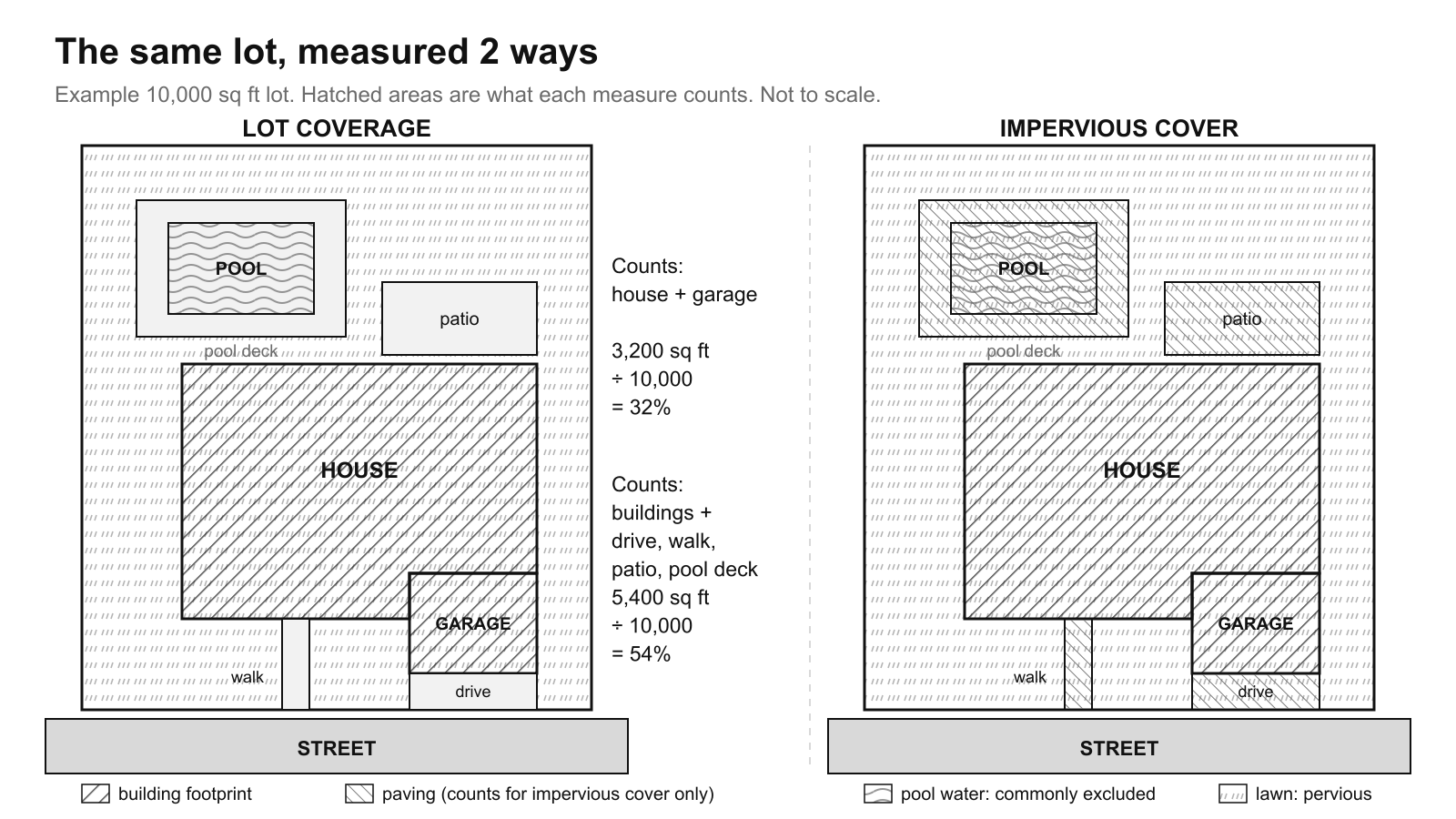
Lot coverage is the share of your lot covered by buildings. Impervious cover is the share covered by anything rain cannot soak through: roofs, driveways, patios, pool decks and walks. Lot coverage limits how much house fits on the lot. Impervious cover limits how much hard surface the lot can shed into the street and the storm system.
Key takeaways
- Lot coverage counts buildings only. Impervious cover counts buildings plus paving, so the impervious number is always equal to or higher than the coverage number.
- In the Houston area, deed restrictions usually set the lot coverage limit. The City of Houston controls impervious cover through its drainage and detention rules rather than a fixed percentage.
- Inside the City of Houston, a single home on a lot of 15,000 sq ft or less needs no stormwater detention if total impervious cover stays at or below 65% of the lot (2025 rule).
- Austin caps impervious cover by zoning district, 45% in the common SF-3 district, and counts an open-joint wood deck at only 50%.
- San Antonio's limits are strictest over the Edwards Aquifer recharge zone, where the aquifer ordinance holds single-family lots inside the city to 30%.
The 2 definitions
What is lot coverage?
Lot coverage is the percentage of the lot area covered by buildings, measured at the outside face of the exterior walls or the edge of the foundation. Most definitions include roofed structures such as garages, porches and carports. A 2,400 sq ft footprint on an 8,000 sq ft lot is 30% lot coverage, and a second floor adds nothing unless it overhangs the first.
What is impervious cover, and what counts toward it?
Impervious cover is every surface on the lot that stops rain from soaking into the ground: the roof footprint plus driveways, walks, patios, pool decks, outbuildings and compacted gravel. Austin's drainage office, for example, lists rooftops, patios, driveways whether paved or not, and parking as impervious cover. Each added square foot sends more runoff, faster, into the street and the storm system, which is why flood-prone regions such as Greater Houston care about it.
What is the difference between lot coverage and impervious cover?
Lot coverage counts only buildings, while impervious cover counts buildings and every hard surface around them, so the impervious figure is always the larger of the 2. Lot coverage usually comes from a zoning district or a deed restriction and protects the look and spacing of the street. Impervious cover usually comes from a drainage, watershed or aquifer rule and protects the people downstream. A design can pass 1 and fail the other: a modest 1-story house with a long motor court, a pool and wide terraces can sit at 30% lot coverage and 60% impervious cover.

Typical limits
What is the maximum building coverage on a typical lot?
Typical single-family lot coverage limits run from about 35% to 65%, with 40% to 50% the most common range on suburban lots and higher figures on small urban lots. The City of Houston has no zoning, so on a standard lot the limit is whatever the deed restrictions say, and some neighborhoods have none. Houston's development ordinance sets a coverage rule only for small platted lots: when a plat creates single-family lots under 3,500 sq ft, the footprint must leave more than 60% of each lot uncovered and each lot must keep at least 150 sq ft of permeable area, a rule repeated in the city's current platting ordinance notes. Austin's common SF-3 district allows 40% building coverage.
How do HOA limits on coverage compare to the city's?
Deed restrictions and homeowners association rules are usually stricter than the city's and are enforced separately, so a design must satisfy both. In Houston the restrictions are often the only coverage limit that exists, and architectural review committees apply them to the letter. Common patterns are a maximum building coverage of 40% to 50%, a separate cap on total paving, a minimum lawn area in the front yard and limits on how much of the rear yard a pool and deck can take. Read the restrictions before buying the lot, a step covered in evaluating a lot before you buy.
What counts and what does not
Does a driveway, patio or pool deck count as impervious cover?
Yes. A driveway, a patio and a pool deck all count as impervious cover in every Texas jurisdiction that regulates it, whether they are concrete, stone or mortared pavers. The water surface of the pool is commonly excluded, since it does not shed runoff, but the coping and the deck around it count in full. On a luxury lot the paving around the house often adds up to as much area as the house, which is why impervious cover is usually the limit that bites first.
Does a covered porch count toward lot coverage?
Usually yes. Most coverage definitions include any roofed area, so covered porches, porte-cocheres, carports and covered outdoor living rooms count toward lot coverage, while uncovered terraces do not. If a design is tight against the coverage limit, an uncovered terrace under a pergola, which has no solid roof, is the usual way to keep outdoor living space without spending coverage on it.
Do pervious pavers and gravel reduce my impervious cover?
Sometimes, and only where the local rule says so. Austin counts an uncovered wood deck with gaps between the boards, set over soil, at 50% of its area, and excludes gravel only where it is laid over soil and used for landscaping or walking, not for driving. Permeable paver systems on an open stone base earn a partial credit in some jurisdictions, with manufacturer data, and none in others. In Houston, credit for permeable pavement is handled case by case in the drainage review rather than as an automatic exclusion.

Drainage and what happens at the limit
How does impervious cover affect drainage and detention requirements?
The more impervious cover a lot has, the more rain it sheds and the more likely the city is to require on-site detention, meaning a pond, an underground tank or an oversized pipe that holds water back and releases it slowly. In the City of Houston the trigger is written directly in impervious cover. Under the May 2025 supplement to Chapter 9 of the Infrastructure Design Manual, a single home on a tract of 15,000 sq ft or less needs no detention if total impervious cover is 65% or less. On a tract larger than 15,000 sq ft the allowance is the greater of 9,750 sq ft or 40% of the tract. Above those lines, detention is required at 0.75 acre-feet per acre of the excess, and tracts of 1 acre or more follow the full rules.

What happens if my design exceeds the impervious limit?
Depending on the jurisdiction, exceeding the impervious limit means redesigning, adding detention, or applying for a variance that may not be granted. Where the limit is a hard zoning cap, as in Austin and over the San Antonio recharge zone, the permit is refused until the number comes down or a board grants a variance, and variances for self-created hardship are rarely granted. Where the limit is a detention trigger, as in Houston, the design can proceed if detention is added, which costs money, yard space and a drainage engineer. The cheapest fix is almost always less paving: a narrower drive, a smaller motor court, a terrace with planted joints or a deck instead of a slab.
Checking the numbers before you commit
How do I calculate coverage before I commit to a floor plan?
Divide the building footprint by the lot area for lot coverage, then add every hard surface to the footprint and divide again for impervious cover, using the survey's lot area and the areas measured from the site plan. On a 10,000 sq ft lot with a 3,200 sq ft footprint, a 1,100 sq ft driveway, 600 sq ft of walks and terraces and a 500 sq ft pool deck, lot coverage is 32% and impervious cover is 54%. Do this at the first sketch, because paving is drawn last and it is what pushes the number over. Check setbacks and easements at the same time, since the buildable area they leave is explained in building setbacks, and read how the lot sheds water in grading and drainage on Houston clay lots.
Houston, Austin and San Antonio
Houston: Chapter 42 and the permeable-area rules
The City of Houston has no zoning and no general lot coverage cap, so on a standard lot the coverage limit comes from deed restrictions and impervious cover is controlled by the drainage rules above. Chapter 42, the city's development ordinance, applies coverage and permeable-area standards only to reduced-size lots: single-family lots platted under 3,500 sq ft must leave more than 60% of the lot open or provide compensating open space, and each must keep at least 150 sq ft of permeable area. Suburban cities such as Bellaire, West University Place and the Memorial villages have their own zoning with hard coverage and impervious limits, so confirm the jurisdiction first.
Austin: impervious cover limits by zoning district
Austin sets both limits in its Land Development Code by zoning district: the common SF-3 district allows 40% building coverage and 45% impervious cover, with stricter watershed limits in sensitive areas. The city's 2024 housing amendments confirm that impervious cover for SF-1, SF-2 and SF-3 lots is still set by the base zoning district, and that garages and carports count toward both measures. Lots in the Barton Springs zone can be limited to 15% to 25%, so ask for the watershed determination before buying.
San Antonio: impervious cover over the recharge zone
San Antonio's tightest limits apply over the Edwards Aquifer recharge zone, where the city's aquifer protection ordinance sets gross impervious cover at 30% for single-family residential inside the city and 15% in the extraterritorial jurisdiction, under Ordinance 81491 as summarized by the water system. The state's Edwards Aquifer program adds a layer for acreage homes: the TCEQ private-residence conditions allow a single residence on more than 5 acres over the recharge zone with no more than 20% impervious cover. Confirm the parcel's aquifer zone with the city's Development Services Department before you size the house.
Planning a home on a tight lot?
The right time to test lot coverage and impervious cover is before the floor plan is drawn. If you are weighing a lot or a plan and want both numbers run against the rules that actually apply to it, start a project with Modern Acre Studio, or see how we approach site planning in our portfolio.