An easement is a recorded right that lets someone other than you, usually a utility or the city, use a strip of your lot. You can build over one only with the easement holder's written consent, and that consent is almost never given for a house, garage, pool or any other permanent structure. Fences and driveways are usually allowed.
Key takeaways
- Easements, plat notes and deed restrictions are recorded against the land and bind every later owner. They sit on top of city rules, and the stricter rule wins.
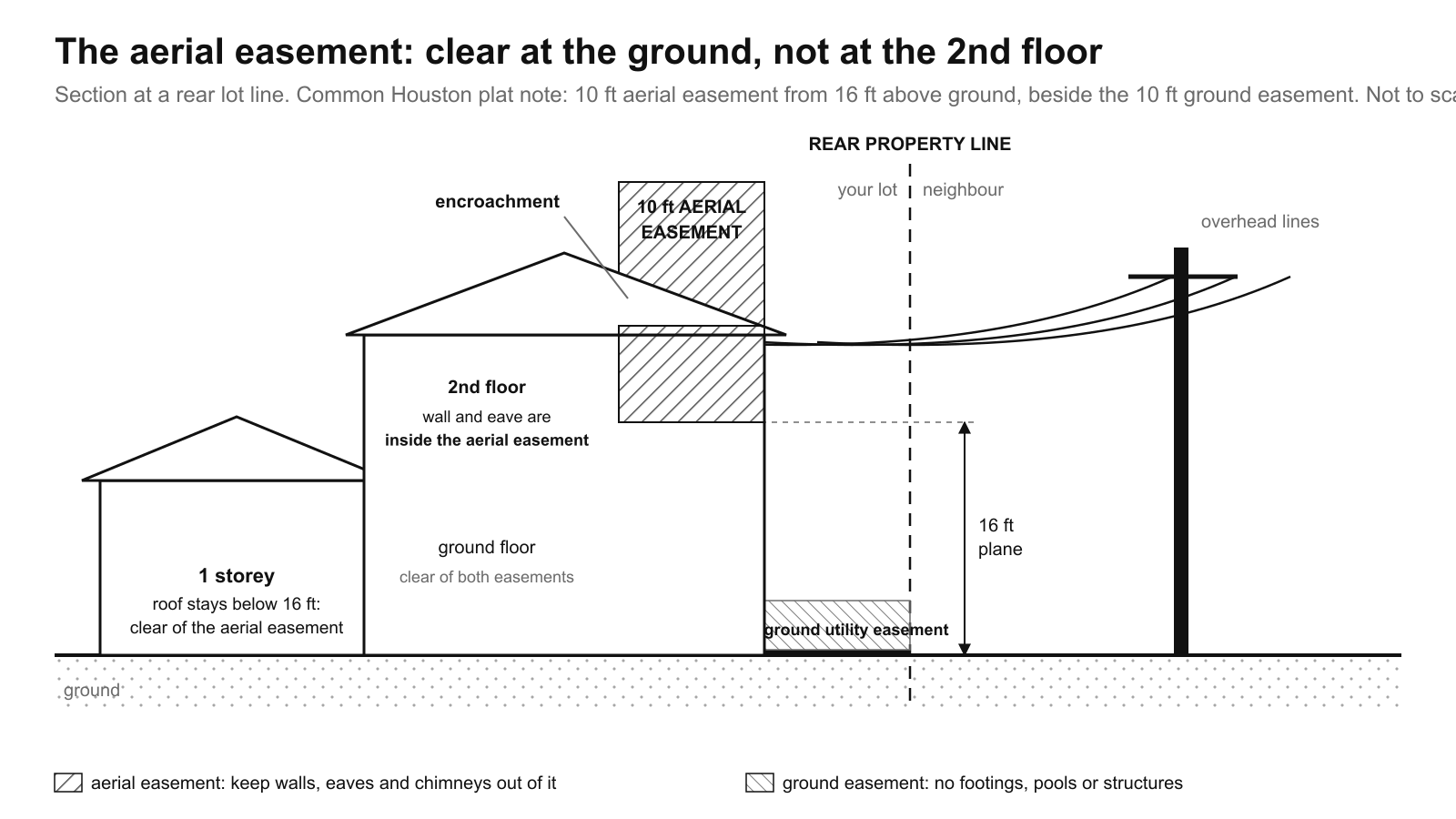
- An aerial easement reserves air space above the ground easement, commonly from 16 ft above grade, so a 2nd storey can be inside it when the ground floor is clear.
- A Texas replat of a lot once restricted to single-family use needs mailed notice and a public hearing. Plan on 2–4 months as a 2026 planning range.
- The City of Houston enforces deed restrictions through its Legal Department because it has no zoning. Austin and San Antonio treat them as private contracts.
- An HOA architectural review committee checks what its recorded declaration lists, and in Texas a denial must be written and can be appealed.
Easements on your lot
What is an easement on a residential lot?
An easement is a legal right, recorded in the county's real property records, that lets a named party use part of your land while you keep ownership. On a typical house lot the common ones are a utility easement along the rear or side line for power, telephone and cable, a drainage easement where a ditch or storm line runs. Most appear on the recorded plat and on your survey as a dashed strip with a width, such as 10 ft U.E. The holder can dig up the strip and remove anything in its way, which is why permanent construction stays out of it.
What is an aerial easement and why does it matter for a second storey?
An aerial easement is an easement in the air above your lot, reserved so overhead power lines and their swing have room, and it matters because a 2nd storey, a roof overhang or a chimney can sit inside it when nothing touches the ground. A common form on Houston-area plats is a 10 ft wide aerial easement beside the ground easement, starting at a plane 16 ft above grade. A 2-storey wall placed at the edge of a rear utility easement can be legal at the 1st floor and an encroachment at the 2nd.

Can I build over a utility easement?
Only with the easement holder's written consent, and for a permanent structure that consent is rarely given. The city's consent to encroachment over a city easement process takes a notarised application, drawings and no-objection letters from CenterPoint and the telephone company, lists a 10-business-day processing time, and ends with the consent recorded against the deed. Fences, driveways and patio slabs that can be removed typically get approved. Footings and pool shells typically get refused. Treat the easement as unbuildable and keep the house, pool and outdoor kitchen clear of it.
The lines on your survey
What is a right-of-way line versus a property line?
The right-of-way line is the edge of the public street corridor, and on most platted lots it is the same line as your front property line. The right-of-way is wider than the pavement: it holds the curb, sidewalk, street trees and poles, so the public strip usually starts several feet onto what looks like your front lawn. Behind it sits the building line, the setback the plat or deed restrictions impose. Measure every setback from the property line, not the curb, which is often 10–15 ft closer to the house than people expect. We cover setbacks in building setbacks explained.

How do I find the easements and restrictions on my own lot?
Start with the recorded plat and the title commitment, then the county clerk's real property records, because together they hold every easement and restriction that binds the lot. The plat shows platted easements and building lines; the title commitment's Schedule B lists recorded easements and the volume and page of the deed restrictions; a current survey draws them on the ground. The Harris County Clerk's online search returns a subdivision's restrictions by name, and the City of Houston's deed restriction FAQ explains how to order copies. Read them before design starts, as we recommend in what to look for in a lot before you buy it.
Plats and replats
What is a platted lot, and what is a replat?
A platted lot is a parcel created by a recorded subdivision plat, the map that divided a larger tract into lots, streets and easements and was approved by the city or county and filed with the county clerk. A replat is a new plat recorded over all or part of an old one to change lot lines, combine or split lots, or move a building line, without cancelling the original. Chapter 212 of the Texas Local Government Code allows this and adds steps when the lots were once restricted to single-family homes.
When do I need to replat, and how long does it take?
You need to replat when you combine 2 lots into 1 home site, split a lot, move a shared line, change a platted building line or abandon a platted easement, and a simple residential replat typically takes 2–4 months from application to recording as a 2026 planning range. Under Section 212.015 of the Local Government Code, a replat of land once limited to 1 or 2 residential units per lot needs written notice to owners within 200 ft at least 15 days before the hearing, and if a variance is requested and owners of 20% of the land within 200 ft protest in writing, approval needs a 3/4 vote. Houston's replat with notification guide runs longer: the Planning Commission sets the hearing about 4 weeks out, the newspaper notice, posted sign and letters to owners within 300 ft go out 20 days before it.

Deed restrictions and the HOA
What are deed restrictions, and who enforces them?
Deed restrictions are private written rules, recorded against every lot in a subdivision, that limit how the land is used and what can be built on it, and they are enforced by the other owners, by the homeowners' association where there is one, and in the City of Houston by the city itself. Typical ones set a minimum house size, a front building line, side and rear setbacks, a height limit, residential use only and rules on fences, materials and driveways. Houston's Legal Department investigates complaints at no charge, sends warning letters and files suit when needed, though it cannot sue over a violation that has run without interruption since before August 1965.
What happens when deed restrictions and city rules disagree?
The stricter rule governs, because the city permit and the deed restrictions are 2 separate approvals and you need both. If the restriction sets a 30 ft front building line and the city minimum is 25 ft, the house sits at 30 ft. Austin says it plainly: a permit that meets the Land Development Code must be approved whether or not it conforms to a deed restriction, and enforcement is a civil matter. Houston differs in one respect: its Planning Commission must disapprove a replat that violates recorded restrictions. The buildable area is the overlap of every rule, the same logic as lot coverage and impervious cover.
Can deed restrictions expire or be amended?
Yes to both: many were written with a 25–30 year term that renews automatically unless a set share of owners votes to end them, some are perpetual, and most can be amended by petition. For subdivisions in Harris County and certain neighbouring counties, Chapter 204 of the Texas Property Code lets a property owners' association petition to extend, add to or modify restrictions, effective when owners of at least 75% of the land sign and it is filed with the county clerk. Have a title attorney confirm the status of any restriction that looks expired, because it may have been renewed years ago.
What does an HOA architectural review committee actually check?
It checks the items its recorded declaration and design guidelines list, which on most Texas subdivisions means setbacks and building lines, height and storey count, exterior materials and colours, roof pitch and form, garage placement, fence type, drainage and grading, and sometimes pool location and construction hours. For associations with more than 40 lots, Section 209.00505 of the Texas Property Code requires a denial to be written, explain the reasons, list the changes that would earn approval and offer a hearing before the board within 30 days. Submit a complete package early, because committees meet monthly and a missing sheet costs a cycle.
How the 3 metros handle it
Houston (deed restrictions do the work zoning would)
Houston has no zoning, so recorded deed restrictions are the main control on use, lot size, building lines and height inside the city, and the city stands behind them as no other Texas metro does. The Legal Department takes complaints by hotline and sues over recorded violations; the Planning Commission meets every other Thursday, must approve a replat that meets Chapter 42 of the city code, and must disapprove one that violates deed restrictions.
Austin
Austin treats deed restrictions as private contracts: its deed restrictions and development page says zoning does not affect their enforceability, that a code-compliant permit must be approved whether or not it conforms to a restriction, and that buyers must check the Travis County Clerk's records themselves. Replats are filed as resubdivisions through the city's subdivision application process, which issues a completeness check within 10 business days and a first formal review 30 calendar days after filing.
San Antonio
San Antonio's Development Services Department states in Information Bulletin 234 that covenants and deed restrictions are not required by the city, that the city was not involved in writing them and will not enforce them, and that only zoning and development ordinances are enforced. Replats follow the Unified Development Code with the same state-law notice and hearing steps; the department's current replat pages could not be verified for this article, so confirm the present steps and timeline with the department.
Design around the rules first
Every custom home we design starts with the survey, the plat and the restrictions on the table, because the buildable area they leave is the real site. If you are weighing a lot or ready to begin, start a project and send us the survey and title commitment, or see how other homes answered their sites in our portfolio. All timelines here are 2026 planning ranges and move with each commission's calendar.