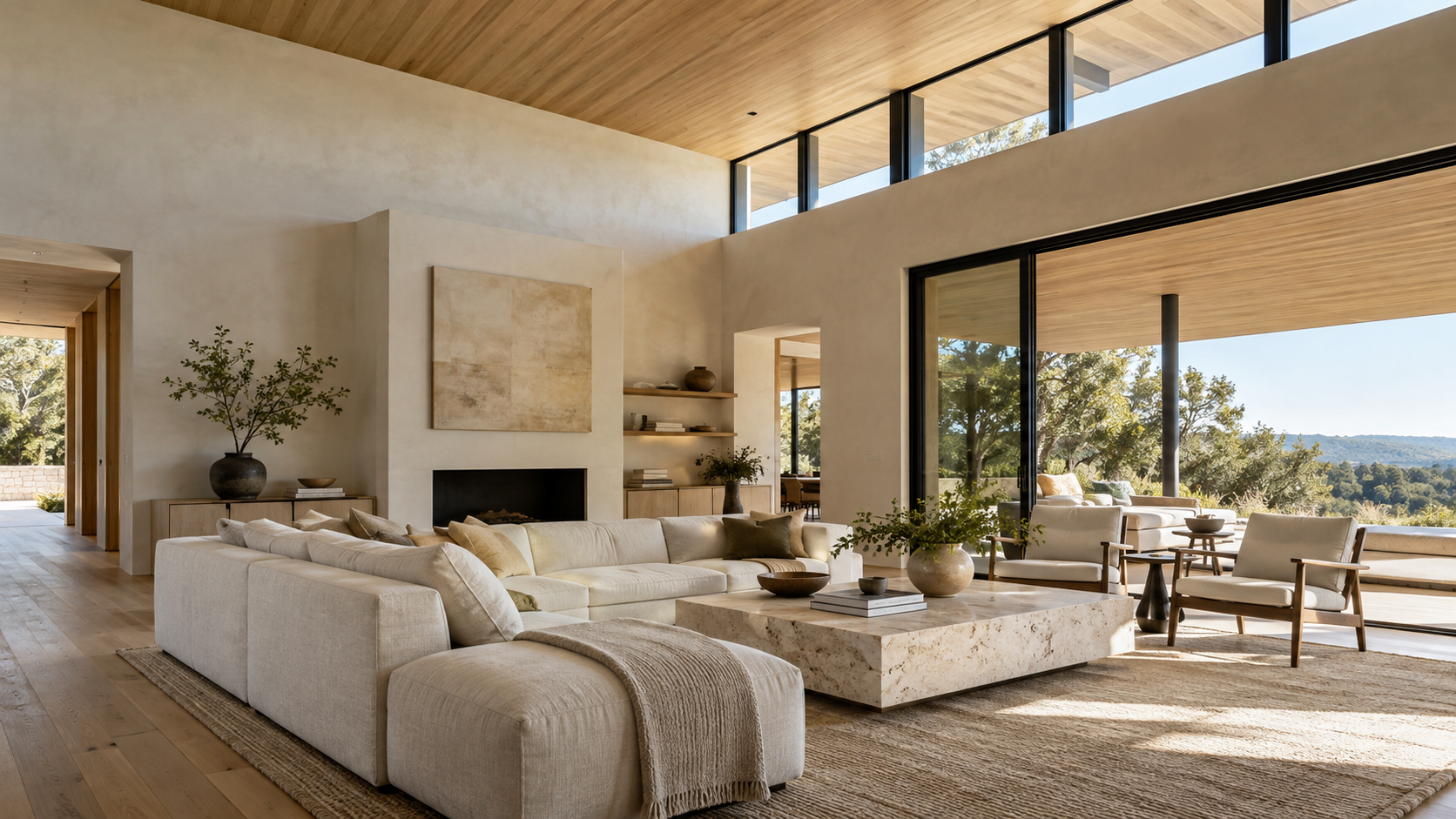
Any room more than about 20 feet from an exterior wall gets little useful daylight from ordinary windows, so the middle of a house has to be lit from above. The three tools are skylights, clerestory windows (a band of glass set high in a wall that rises above a lower roof), and tubular light tubes, and each one solves a different problem.
In our earlier piece on daylight we looked at where the perimeter windows go. This article is about the rooms those windows can't reach: the inner hallway, the walk-in closet, the primary bath with no outside wall, the stair hall in the center of a wide plan.
Key Takeaways
- Clerestories give the most even, controllable light and are usually our first choice for living spaces in hot climates.
- Skylights deliver the most light per square foot of glass, but also the most heat. Keep them small, deep-set, and off the west and south roof slopes where possible.
- Light tubes are the cheapest way to bring real daylight into closets, laundry rooms, and hallways, but they give no view and no sky.
- All three are decided by the roof and section, so they belong in schematic design, not on a change order.
Why the Middle of a House Goes Dark
Side windows throw usable light roughly one and a half to two times the window head height into a room. With a typical 8-foot head, that means good light ends somewhere around 12 to 16 feet in. Wide luxury plans, single-story homes in particular, often put halls, baths, and closets well beyond that line.
Light from above behaves differently. The sky overhead is brighter than the horizon, and light that comes down lands on the floor and walls where you actually see it. A small opening in the roof can do the work of a much larger window in the wall.
Clerestory Windows: Soft Light With a Roofline to Match
A clerestory is a row of windows set high in a wall where one roof steps above another. Because the glass is vertical, it takes in far less midday sun than a skylight, and a roof overhang can shade it completely in summer while letting low winter sun through.

Where clerestories work best
We reach for them over living rooms, kitchens, and long central halls, anywhere the roof can step. North-facing clerestories give steady, glare-free light all day. They also keep wall space below for art, millwork, and furniture, and they add privacy on tight lots because nobody can see in.
The trade-off
A clerestory needs a change in roof height, so it shapes the exterior massing. That is usually a design opportunity, but it has to be drawn from the start. Operable clerestory units also need motorized operators, since nobody reaches a window 14 feet up.
Skylights: The Most Light, and the Most Heat
A skylight looks straight at the sky, so it brings in the most light for its size. A 2-by-4-foot skylight can light a whole bathroom. That same exposure is the downside: a flat or low-pitched skylight faces the high summer sun head-on.
How we design skylights so they don't overheat
- Keep them small and use more of them, rather than one big pane.
- Set them in a deep, splayed light well. The angled sides spread the light and block direct sun at its harshest angles.
- Specify low-solar-gain glass and a factory-installed shade, motorized if the skylight is out of reach.
- Favor north and east roof slopes over west and south whenever the plan allows.

A skylight over a shower or tub is one of the best uses we know. The room gets daylight and full privacy at once, which a wall window rarely offers.
Light Tubes: Daylight for Closets, Halls, and Laundry
A light tube, sometimes called a tubular skylight or sun tunnel, is a small clear dome on the roof connected to a highly reflective tube that runs down through the attic to a diffuser in the ceiling. It looks like a light fixture from below, but it carries daylight.
Tubes cost a fraction of a skylight, run easily through a deep attic, and add very little heat. They are ideal for walk-in closets, where you want true daylight to judge color, and for pantries, laundry rooms, and windowless halls. The limit is that they give light without a view: you will never see a cloud through one.
How to Choose: A Simple Rule of Thumb
- Living spaces with a roof that can step: clerestory.
- Baths, stair halls, and rooms where seeing the sky matters: a small, well-shaded skylight.
- Closets, pantries, laundry, and short halls under a deep attic: light tube.
- Rooms with a second floor above them: none of the three reach easily, so rethink the plan, use an interior glass transom, or borrow light through an open stair.
What Changes in Houston's Climate
In Houston, Fulshear, and Brazoria County, heat gain is the deciding factor. Summer sun is close to overhead for months, so a large flat skylight can feel like a heater in July. That is why we lean toward clerestories with real overhangs for main rooms, and keep skylights small and shaded.
Water and wind matter too. Every roof opening is a potential leak, so we specify factory curb-mounted units with proper flashing kits, and impact-rated or laminated glass where wind exposure calls for it. Hail is part of the Texas picture as well, which is another reason to favor vertical glass where you can.

Frequently Asked Questions
Do skylights always leak?
No. Most leaks come from site-built curbs and poor flashing, not the skylight itself. A factory-made unit with the maker's own flashing kit, installed on a properly sloped roof, performs well for decades.
Are clerestory windows energy efficient?
They can be among the most efficient ways to daylight a house. Vertical glass under an overhang blocks summer sun, admits winter sun, and cuts daytime lighting use. Facing them north gives even light with very little heat.
Is a light tube enough to light a whole room?
A 10- to 14-inch tube comfortably lights a closet, pantry, or 100 to 200 square feet of hallway on a bright day. For a living space you want a view of the sky, so a clerestory or skylight is the better tool.
When do we need to decide?
In schematic design. All three depend on roof shape, attic depth, and framing, so adding them later costs far more. If you are planning a home with deep interior rooms, start a conversation with the studio and we will work the daylight into the section from the first sketch.