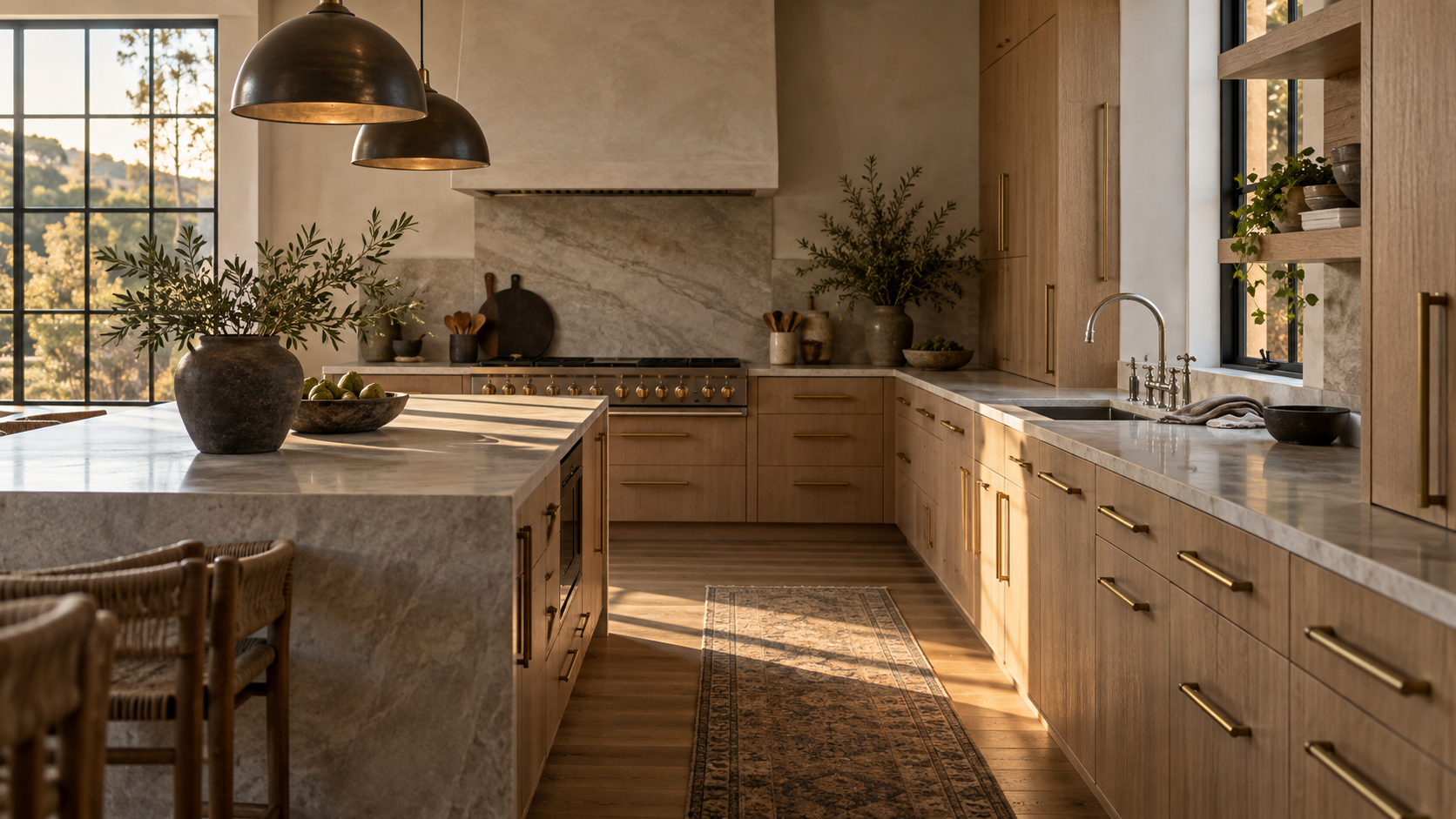
You can mix metal finishes in a house, and most well-designed homes do. The trick is to give each metal a role, hold it to two or three finishes per room, and repeat every one of them at least twice so the mix looks planned rather than accidental.
Matching everything to one finish was the safe rule for a long time. It also produces rooms that feel like a showroom package. As interiors move toward warmer, more personal palettes, we get asked this question in almost every selections meeting: can the faucet be nickel if the pulls are brass? It can. Here is how we decide.
Key Takeaways
- Use two or three metals per room, never more.
- Choose one dominant finish and let the others support it, roughly a 60/30/10 split.
- Assign metals by job: one for cabinet hardware, one for plumbing, one for lighting.
- Repeat every finish at least twice in the same room.
- Treat stainless appliances and matte black as neutrals, not as a third metal.
- Decide finishes during design, not piece by piece at the showroom.
Start With One Dominant Metal
Every room needs a lead. It is usually the finish that appears most often and at the largest scale: cabinet pulls across a run of drawers, a range hood band, or a set of pendants over an island.
Warm metals (brass, bronze, copper) and cool metals (polished nickel, chrome, satin nickel) both work as leads. What matters is that the dominant finish clearly outnumbers the others. When two metals appear in equal amounts, the eye reads a disagreement instead of a palette.

Give Each Metal a Job
The simplest way to make a mix look intentional is to assign finishes by category. When a guest sees that every pull matches and every faucet matches, the difference between the two reads as a system.
Cabinet and Door Hardware
This is usually the dominant metal because there is so much of it. Brass and bronze are popular here because hands touch them daily, and a living finish wears in rather than wearing out.
Plumbing Fixtures
Faucets, shower trim, and valves often carry the second finish. Polished or satin nickel pairs well with warm hardware and is forgiving with water spots. Plumbing is also the hardest metal to change later, so we choose it most carefully.
Lighting
Lighting is the natural place for the accent. A blackened or oil-rubbed fixture adds depth without competing, or a pendant can repeat the hardware metal to tie the room together.
Warm and Cool Together
Mixing one warm metal with one cool metal is the most reliable pairing we specify. Brass with polished nickel, bronze with satin nickel, and copper with chrome all hold together because the contrast is obvious and therefore looks chosen.
Two warm metals that are close but not identical, such as a bright brass beside a champagne bronze, cause more trouble than a true contrast. They look like a mistake in ordering rather than a design choice. If you want two warm tones, make the difference strong.

Repeat Every Finish at Least Twice
A single brass item in an otherwise nickel room looks like it was left over from another project. Two or three appearances, spread across the room, turn it into a thread. In a kitchen that might mean brass pulls, a brass rail at the range, and brass picture lights on open shelving.
The same logic carries from room to room. We usually keep the dominant hardware metal consistent through connected public spaces so the house reads as one idea, then let bathrooms and bedrooms shift within the same family.
What Counts as a Neutral
Stainless steel appliances and matte black are not part of the count. Stainless is expected in a kitchen and disappears next to cabinetry. Matte black behaves like a dark paint color: window frames, steel doors, and black fixtures sit in the background and let the real metals lead.
Metal Finishes in Houston's Humidity
Unlacquered brass and raw copper patinate faster in the Gulf Coast's humid air, especially in bathrooms and on exterior doors. Some clients want that aging, and we design for it. Others prefer the look to hold, and for them we specify PVD (physical vapor deposition, a hard factory-bonded coating) finishes that resist tarnish and wear.
Near the coast in Brazoria County, salt air speeds corrosion on exterior hardware and light fixtures. There, we lean on marine-grade stainless, solid bronze, or PVD-coated metals outside, and keep the living finishes indoors where the conditions are controlled.

How We Plan Finishes on a Project
We set the metal palette during design development, in the same pass as stone, wood, and paint, and list it room by room on a finish schedule. Doing it this way means the plumbing rough-in, the lighting plan, and the millwork drawings all agree before anything is ordered. If you are starting to collect ideas, start a conversation with the studio and bring photos of finishes you love.
FAQ
Is it okay to mix brass and nickel in the same kitchen?
Yes. It is one of the most dependable pairings. Let one lead, usually brass on the hardware, and keep nickel on the faucet and pot filler.
How many metal finishes are too many in one room?
More than three. Past that point the room starts to feel like a collection of separate purchases rather than a single design.
Should door hardware match throughout the whole house?
Mostly, yes. Interior door hardware is seen from room to room, so we keep it consistent and save variation for cabinetry, plumbing, and lighting.
Will unlacquered brass look dirty over time?
It darkens and softens, and in high-touch spots it stays brighter. Think of it like a leather bag breaking in. If you want it to stay bright, choose a PVD or lacquered finish instead.