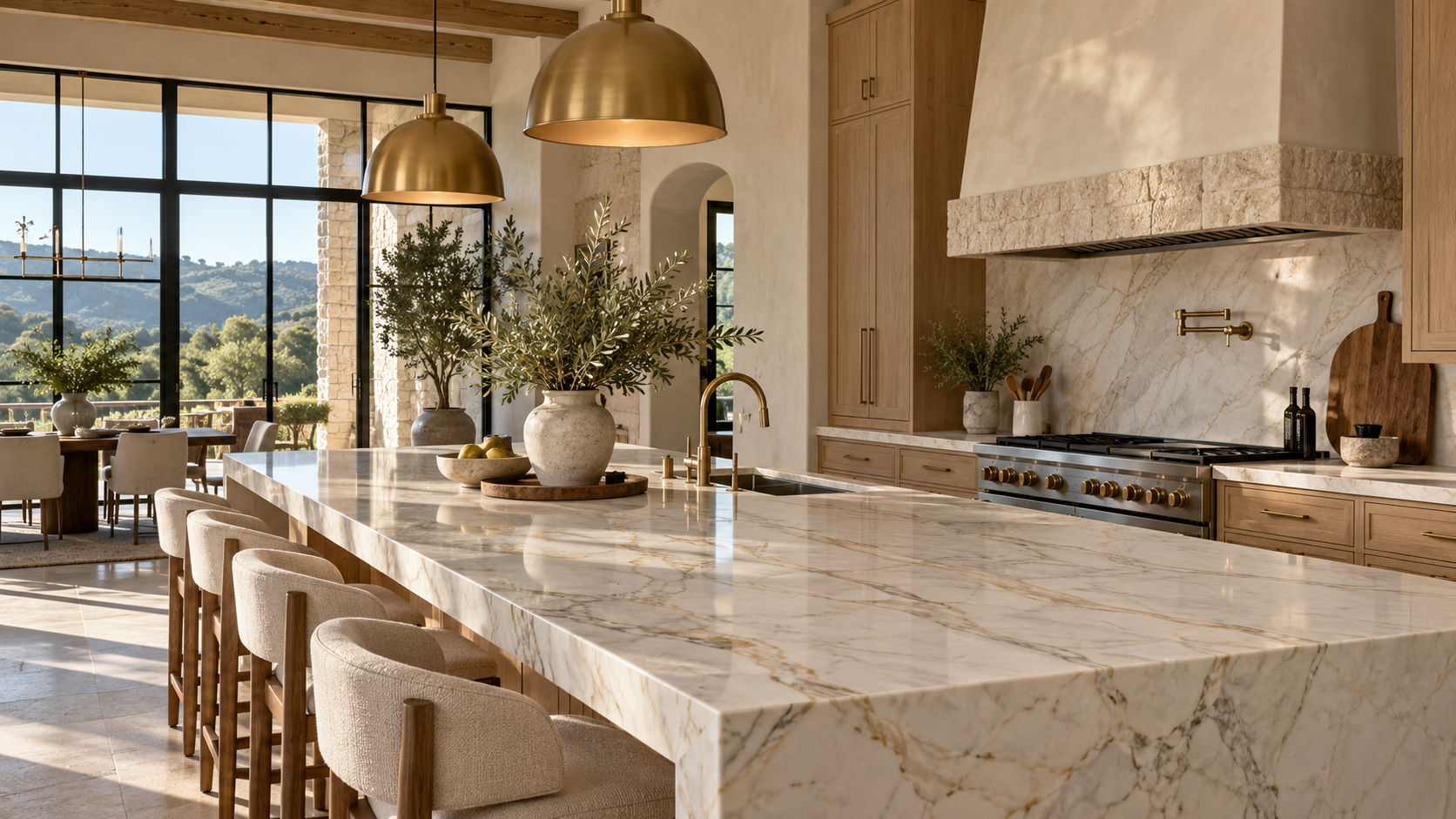
The right kitchen countertop is the one that matches how you actually cook and how much patina you can live with. Quartzite is the hardest natural stone, engineered quartz is the lowest-maintenance surface, marble etches and ages beautifully, and porcelain slab handles heat better than any of them.
As experts in home design, we see countertop choices go wrong in one predictable way: the slab gets picked for how it looks under showroom lights, and nobody asks how it will hold up to lemon juice, a hot pan, or a teenager. This guide walks through the four surfaces we specify most in custom kitchens and where each one earns its place.
Key Takeaways
- Quartzite is natural stone that is harder than granite and resists etching far better than marble, but true quartzite and soft 'quartzite' look-alikes are easy to confuse.
- Engineered quartz is consistent and nearly maintenance-free, but direct heat can scorch its resin, and it can fade in strong sun.
- Marble etches and stains; choose it only if you want a surface that records the life of the kitchen.
- Porcelain slab is thin, heat-proof and UV-stable, which makes it strong for outdoor kitchens, but edge profiles are limited.
- Many of the best kitchens mix two surfaces: a durable perimeter and a statement island.
Quartzite: The Toughest Natural Stone
Quartzite is sandstone that heat and pressure turned into dense, glassy stone. It rates around 7 on the Mohs hardness scale, so it resists scratches and, unlike marble, shrugs off most acids. It also carries the soft veining many homeowners want from marble.
The catch is the name. Some slabs sold as quartzite are really dolomite or marble, which will etch. Before committing, we ask the fabricator for a scratch test with a glass tile and a lemon test on an offcut. If the glass scratches and the lemon leaves no dull mark, it is the real thing.

Engineered Quartz: The Easiest to Live With
Engineered quartz is crushed quartz bound with resin and pigment. It is non-porous, never needs sealing, and every slab matches the sample, which makes it a calm choice for busy family kitchens and long runs of perimeter counter.
Where quartz falls short
The resin is the weak point. A hot pan set straight down can leave a yellow scorch mark, and strong sunlight can fade it over the years, so we keep it out of outdoor kitchens and sun-washed breakfast bays. Look-alike marble patterns have improved, but up close the veining can still read as printed rather than grown.
Marble: For Kitchens That Welcome Patina
Marble is softer and calcium-based, so acids like vinegar, citrus, and tomato sauce leave dull etch marks, and oils can stain. A honed finish hides etching far better than polished. Choose marble if you love the look of a European kitchen that wears in over decades, not if you want a surface that looks new forever.
We often use marble where it is touched gently: a baking station, a backsplash, a powder-room vanity. That way the client gets the material they love without fighting it at the sink every night.

Porcelain Slab: Heat-Proof and Built for Outdoors
Large-format porcelain slabs are fired clay, usually 12 to 20 millimeters thick. They are non-porous, heat-proof, scratch-resistant and UV-stable, so they will not fade on an outdoor kitchen under the Texas sun. Their thin profile suits a crisp, modern look.
The pattern is printed on the surface, though, so a chipped edge shows a plain body underneath. That limits edge profiles to simple eased or mitered edges, and it puts the fabricator's skill front and center. Ask to see a finished mitered corner before you sign.

How We Help Clients Decide
Our design experts start with three questions: who cooks, how often, and how much wear is acceptable. A household that cooks nightly with citrus and cast iron lands in a different place than a couple who mostly entertain.
- Match the surface to the zone: tough material at the sink and range, the statement stone on the island or bar.
- Choose slabs in person, at the yard, and tag the exact pieces you want.
- Ask for a seam layout before fabrication so seams never land across a dramatic vein.
- Plan edge thickness early, since a thick mitered edge affects cabinet heights and appliance clearances.
Countertops are only one layer of a kitchen that works. If you are planning a new home and want expert guidance on materials from the first sketch, start a conversation with the studio.

Frequently Asked Questions
What is the most durable kitchen countertop?
For scratches and heat combined, porcelain slab and true quartzite lead. Quartz is the easiest to maintain day to day, but it does not like direct heat.
Is quartzite better than quartz?
Neither is better across the board. Quartzite is natural, heat-tolerant and one of a kind but needs sealing. Quartz never needs sealing and is consistent, but it can scorch and fade.
Can you put marble in a kitchen you actually cook in?
Yes, if you choose a honed finish and accept etching as character. Many clients put marble on the island and something tougher by the sink.
When should countertops be chosen in the design process?
Early. Slab size, edge thickness and seam locations affect cabinet layout, so our expert design team settles the material during design development, not after construction starts.