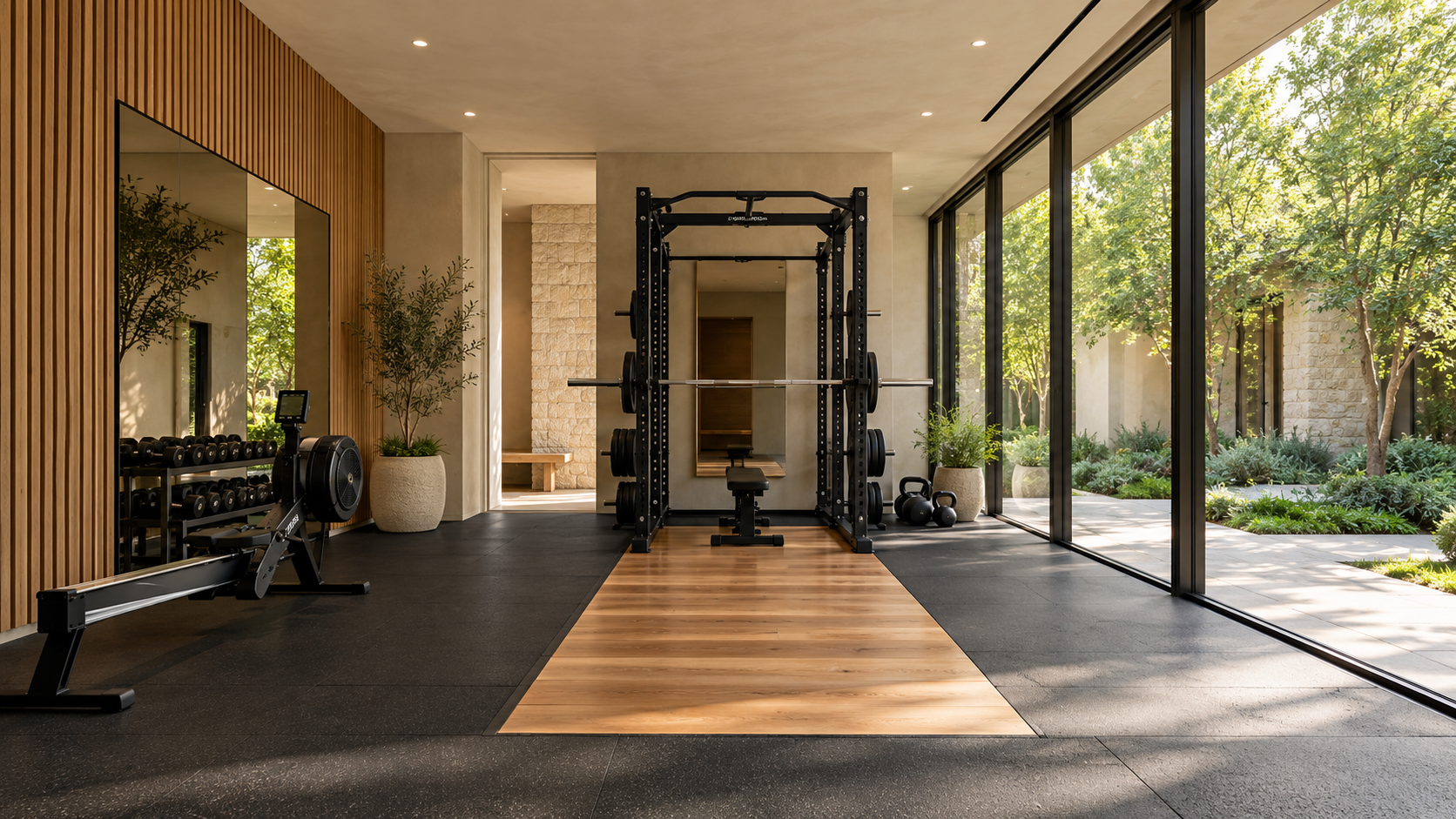
A home gym works when four things are settled during design, not after move-in: a floor that can take dropped weight, a ceiling high enough to lift overhead, dedicated air and cooling, and sound isolation from the rest of the house. Get those right and the room gets used. Skip them and it becomes a spare bedroom with a treadmill in it.
We are seeing more clients ask for a real training room rather than a corner of the garage. The good news is that none of the four requirements is expensive when it is drawn on the plans. They only get expensive when someone tries to retrofit them.
Key Takeaways
- Put the gym on a slab-on-grade floor whenever you can. Upper-floor gyms need structural design for impact and vibration, not just weight.
- Plan for at least 10 feet of clear ceiling if anyone presses overhead, jumps, or uses a rower with a tall stroke.
- Give the room its own cooling zone and fresh-air supply. A gym produces heat and moisture fast.
- Isolate sound with mass, decoupled framing, and a solid-core door, and keep the gym away from bedrooms.
- Decide on equipment before framing so outlets, mirrors, TV, and anchor points land where they are needed.
Where the Gym Goes in the House
Placement drives every other decision. The best location is on the ground floor, on the slab, near the garage or mudroom so you can come in from a run without crossing the living room. A gym next to the wellness suite or a pool bath also makes sense, since showers and towels are already there.
Keep it away from bedrooms and the home office. Even with good isolation, a dropped dumbbell at 6 a.m. travels through framing. A short hallway or a closet between the gym and a quiet room does more than any product you can buy.

The Floor: Built for Impact, Not Just Load
Weight alone is rarely the problem. A rack and a few hundred pounds of plates spread over a floor is ordinary. The problem is impact and vibration: plates landing, jump training, a treadmill belt running for an hour. On a concrete slab that energy goes into the ground. On a wood-framed upper floor it goes into the joists and the rooms below.
On a slab
We specify a thick rubber floor, typically 3/4 inch, and a dedicated lifting platform where heavy lifts happen. The rubber protects the slab and quiets the room. If the slab will be a finished floor elsewhere, we keep the gym finish flush so there is no awkward step at the door.
On an upper floor
It can work, but it is a structural design job. The engineer sizes the floor for vibration as well as load, which often means deeper joists, tighter spacing, or a floating floor assembly on isolation pads. If heavy free weights are part of the plan, we steer them downstairs and keep the upstairs room for cardio, mobility, and yoga.
Ceiling Height and Room Size
Standard 8 or 9 foot ceilings fail fast in a gym. Pressing a bar overhead, box jumps, jump rope, and some rowers and climbers all need more room. We plan for at least 10 feet of clear height, and more if a ceiling fan or light fixture hangs into that space.
For size, a room around 12 by 16 feet fits a rack, a bench, one cardio machine, and open floor for stretching. Add a second cardio machine or a cable system and you are closer to 16 by 20. Recessed lights and flush ceiling fans keep the full height usable.

Air, Cooling, and Moisture
A gym in use behaves like a small sauna. Bodies produce heat and moisture quickly, and a room sharing a thermostat with the rest of the floor will either be too hot during a workout or overcool the house trying to catch up. We give the gym its own cooling zone, with a supply of fresh outdoor air and an exhaust path so stale, damp air leaves the room.
Operable windows help on mild days, and a ceiling fan moves air across the body more cheaply than lowering the setpoint. A dehumidification strategy matters as much as the cooling itself, especially in a humid climate.
Sound Isolation
Isolation comes from three things: mass, separation, and sealing. Walls get two layers of drywall on resilient channels or staggered studs with insulation in the cavity. The door is solid-core with seals at the head, jambs, and threshold. Ductwork gets lined runs or a bend so sound does not travel through the supply registers.
Music and a TV are part of most workouts, so we also treat the inside of the room. Acoustic wall panels or a slatted wood wall over absorptive backing keeps the space from sounding like a parking garage.

What Changes in Houston
Garage gyms are common here, and in a Houston summer a standard garage can run well past 100 degrees with near-saturated air. If the gym shares space with the garage, it needs to be fully inside the insulated envelope with its own conditioning, not a mini-split added later to a vented room. Rubber floors and steel equipment both suffer in a damp space, so dehumidification is not optional.
On lots in Fulshear and Brazoria County where the slab sits higher for flood elevation, a ground-floor gym still works well. We simply plan the door and threshold details so the gym connects cleanly to the garage or yard. If you are planning a house with a training room in mind, start a conversation with the studio.
Frequently Asked Questions
Can a home gym go on the second floor?
Yes, if the floor is engineered for impact and vibration. Cardio, mobility, and light weights are fine upstairs. Heavy free weights belong on a slab.
How big should a home gym be?
About 12 by 16 feet fits a rack, a bench, one cardio machine, and open floor. Plan larger if two people train at once.
What flooring works best in a home gym?
Thick rubber, around 3/4 inch, with a wood or rubber lifting platform where heavy lifts happen. It is durable, quiet, and easy to clean.
Does a home gym need its own HVAC?
It should have its own zone. A gym heats up and adds moisture quickly, and a shared thermostat either overheats the gym or overcools the rest of the house.