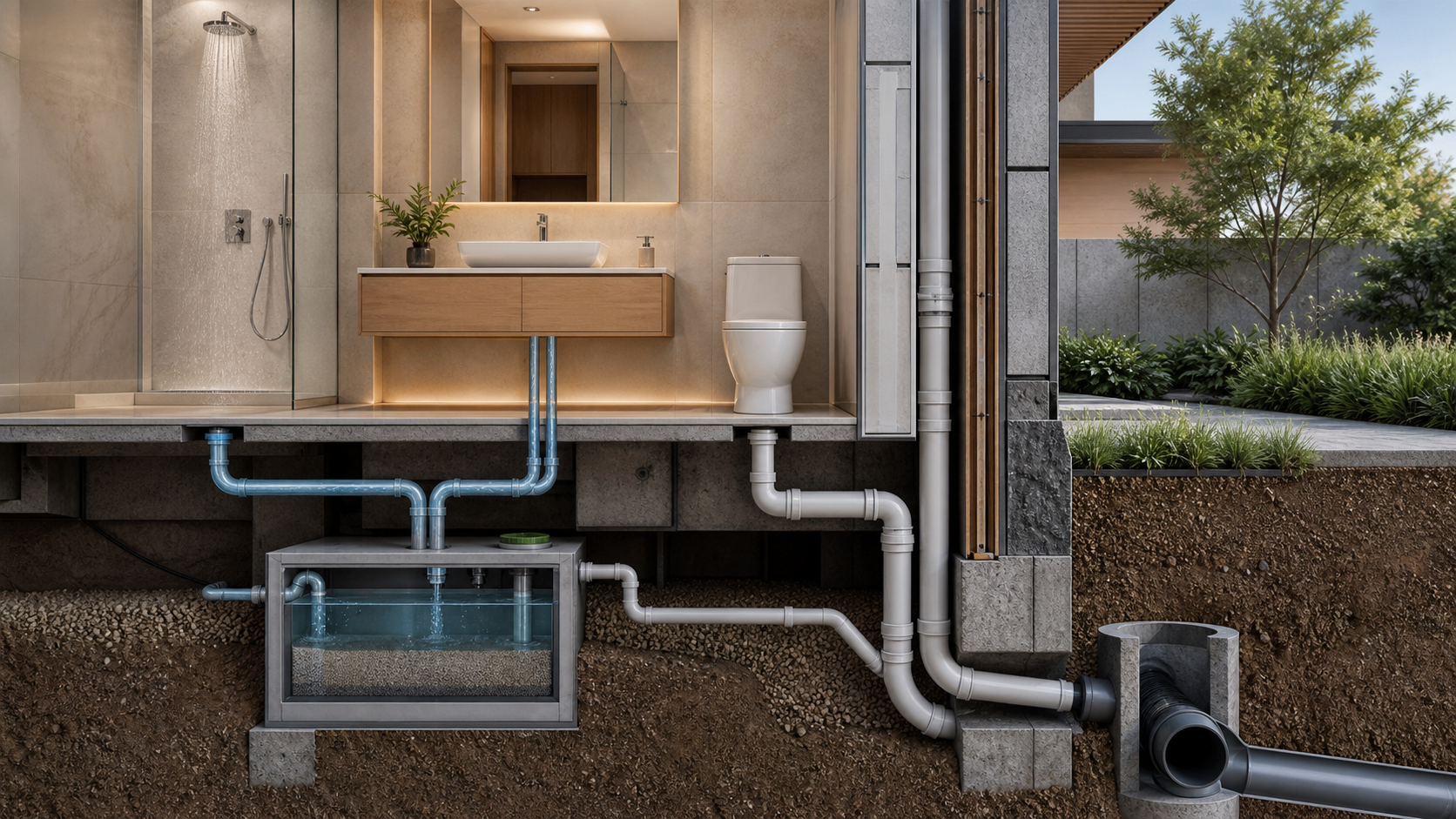
Greywater recycling captures the water from your showers, bathroom sinks, and laundry, filters it, and reroutes it to irrigate landscaping or flush toilets instead of letting it disappear down the sewer line. In a well-designed custom home, a greywater system can cut total household water use by 30-40% without the homeowner changing a single daily habit.
For years greywater recycling lived in the same bucket as backyard rain barrels: a nice idea, rarely built into serious residential architecture. That's changing fast. As Gulf Coast water bills climb and municipal water restrictions become a summer ritual, greywater systems are moving from eco-novelty to a standard line item on luxury new-build spec sheets, right alongside smart irrigation and tankless water heaters.
Key Takeaways
- Greywater is water from showers, bathroom sinks, and laundry — not toilets or kitchen sinks, which count as blackwater and require separate handling.
- A basic laundry-to-landscape system costs a few thousand dollars; a whole-home filtered system with toilet reuse runs into the low five figures.
- The plumbing split has to happen at rough-in — retrofitting a finished custom home is disruptive and expensive.
- Texas plumbing code treats greywater as a regulated system, so it needs to be designed by your architect and engineer, not bolted on after the certificate of occupancy.
Why Greywater Is Showing Up in More Design Briefs
Three things are pushing greywater into the mainstream design conversation. First, outdoor irrigation is often the single largest water draw on a large residential lot, especially for the kind of mature landscaping and turf that comes with a custom estate. Second, municipal utility districts across Fort Bend, Brazoria, and Harris counties have started tightening summer watering schedules, and homeowners want a hedge against those restrictions. Third, greywater reuse quietly supports a home's overall sustainability story, which increasingly matters to buyers comparing one architect-designed home against another.
None of this requires an off-grid, homestead-style commitment. The systems we're specifying into luxury projects now are quiet, automated, and invisible once installed — a homeowner never touches the greywater tank, they just notice the water bill and the irrigation system doing its job through a dry August.
What Counts as Greywater (and What Doesn't)
Greywater is gently used water from bathroom sinks, showers, tubs, and washing machines. Water from toilets and kitchen sinks is classified as blackwater because of higher contamination risk from food waste and human waste, and it always goes to the sewer or septic system, never into a reuse loop. This distinction is what makes greywater plumbing manageable: it's a parallel drain system for a specific, predictable set of fixtures, not a rebuild of the whole house.

Two Tiers of System, Two Very Different Budgets
Greywater systems fall into two broad categories, and the gap between them is significant enough that it should be settled early in design, not during construction.
Laundry-to-Landscape and Simple Branched Drain Systems
The simplest approach reroutes a single source, usually the washing machine or one shower, directly to mulch basins around trees and landscaping beds. No pump, no filtration tank, no electronics — gravity and a diverter valve do the work. These systems run a few thousand dollars installed and are the easiest entry point for a custom home that wants meaningful water savings without added mechanical complexity.
Filtered Whole-Home Systems with Toilet Reuse
The more ambitious version collects greywater from every shower, tub, and bathroom sink in the house, runs it through a filtration and disinfection tank, and stores it for both irrigation and toilet flushing. This tier needs a dedicated equipment room, a secondary pump, and NSF-certified filtration components, and it typically lands in the low five figures once installed. For a large estate lot with significant irrigation demand, the payback period is still reasonable, and the system becomes part of the home's mechanical narrative alongside the HVAC and water heating plant.
Where Greywater Has to Live in the Design Process
The single biggest mistake we see is treating greywater as an add-on decided after floor plans are locked. The reuse tank needs a location — usually a mechanical yard or basement mechanical room — with access for filter maintenance. The plumbing set needs a second drain stack that never touches the blackwater line. And the irrigation designer needs to know the flow rate and pressure the system will actually deliver, because greywater output rarely matches a standard potable irrigation zone. Getting this sequence right means greywater has to be on the table during schematic design, not value-engineered in during construction documents. If you want to talk through how this fits your lot and landscaping plan, start a conversation with the studio.
Texas plumbing code (adopted from the Uniform Plumbing Code with state amendments) treats greywater reuse as a regulated system requiring a permit, backflow prevention, and clear signage on any greywater-fed fixture or spigot. That's a good thing for the homeowner — it means the system is inspected and documented — but it also means it can't be a handyman afterthought. It needs an engineer of record and a clean set of drawings, the same as any other building system.

What Greywater Reuse Actually Saves
For a typical large custom home with significant landscaping, irrigation can account for well over half of total water use during Houston's hot months. Redirecting shower, sink, and laundry water into that irrigation demand can offset a large share of it directly, and whole-home systems that also feed toilet flushing push total household water savings into the 30-40% range. On a Gulf Coast utility bill, especially one tied to a municipal utility district with tiered summer rates, that's a meaningful and permanent reduction, not a one-season fix.
FAQ
Does greywater recycling work with a septic system?
Yes, and in many rural Fort Bend and Brazoria County lots it actually reduces load on the septic drain field, since less water is going to the tank. Your engineer will size the septic system and the greywater diversion together so neither is overloaded.
Can greywater systems be added to an existing home instead of a new build?
It's possible but far more invasive, since it usually means opening walls and floors to separate existing drain lines. Simple laundry-to-landscape retrofits are reasonable; whole-home filtered systems are much easier to justify during new construction or a full gut renovation.
Is stored greywater safe around kids and pets?
Greywater is stored for a maximum of 24 hours before code requires it be used or discharged, precisely to prevent bacterial growth, and any greywater-fed outdoor spigot is required to be clearly labeled as non-potable. It's not intended for contact use, only subsurface irrigation and toilet flushing.
Does a greywater system add resale value?
It's increasingly viewed as a performance feature similar to solar or a high-efficiency HVAC plant — not universally demanded, but a clear differentiator for buyers who are comparing sustainability credentials across comparable custom homes.
Building It In From the Start
Greywater recycling is a good example of a system that's cheap to design and expensive to retrofit. The cost difference between planning a second drain stack on paper and cutting one into a finished slab is not small. If water-wise design is part of your goals for a new custom home, it belongs in the very first conversations with your architect, alongside orientation, HVAC strategy, and landscaping — not as a change order six months into framing.