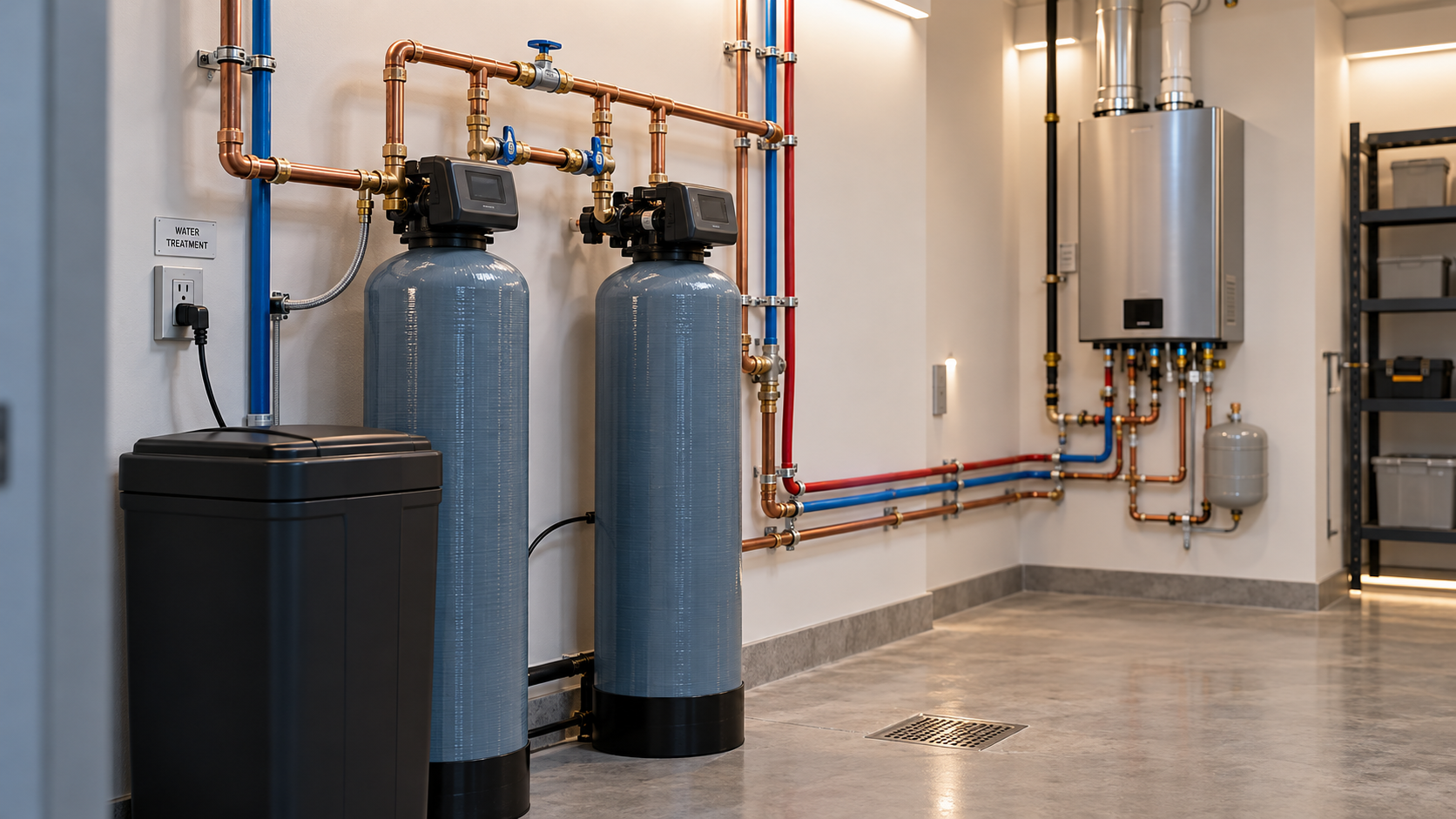
Most custom homes benefit from a whole-house water filter, and many also need a softener — but the right system depends on a water test, not a sales pitch. What matters just as much is where the equipment lives: a filter and softener need floor space, a drain, power, and service access, and those are far easier to draw than to retrofit.
We get this question more often now that clients are thinking about wellness in the structure of the house itself — air, light, and water — rather than in add-on gadgets. Here is how the studio approaches water treatment during design.
Key Takeaways
- Test your water before choosing equipment. Hardness, disinfectant type, iron, and lead decide the system.
- A whole-house water filter removes taste, odor, and disinfectant at the point of entry; a softener removes hardness minerals. They do different jobs.
- Many municipal systems, Houston's included, disinfect with chloramine, which needs catalytic carbon rather than standard carbon.
- Plan a dedicated equipment space with a floor drain, an outlet, a bypass loop, and clear room to change media.
- Add a reverse osmosis unit at the kitchen sink for drinking water if your test calls for it.
Filter, Softener, or Both: What Each One Does
People use "water filter" and "water softener" as if they were the same thing. They are not, and buying one when you needed the other is the most common mistake we see.
Whole-house filtration
A point-of-entry filter sits where the water line enters the house and treats every tap. Its main job is removing sediment, disinfectant, and the taste and smell that come with them. The result shows up in showers and laundry as much as in a glass of water.
Softening
A softener uses ion exchange to pull calcium and magnesium out of the water. That stops scale on glass shower enclosures, plumbing fixtures, tankless water heaters, and dishwashers. A softener does not remove chloramine or improve taste on its own, which is why the two systems are often paired.

Start With a Water Test
Before choosing any equipment, we ask clients to get a lab water test, or at least read the utility's annual water quality report. Well water needs a full lab panel; city water still varies by neighborhood and by the age of the pipes feeding your street.
The test tells you four things that size the system: hardness in grains per gallon, which disinfectant the utility uses (chlorine or chloramine), iron or sulfur content, and any lead or other contaminants that call for point-of-use treatment.
The Houston detail: chloramine
The City of Houston, like many large systems, disinfects with chloramine instead of plain chlorine. Chloramine is more stable, which is good for the utility, but standard activated carbon removes it poorly. A whole-house system here should use catalytic carbon or a filter rated specifically for chloramine reduction. Greater Houston water also tends to run moderately hard, so most of our local clients end up with a filter and a softener together.
Where the Equipment Goes
This is where design makes the difference. Treatment equipment is bulky, it needs maintenance, and it needs to sit before the water heater so heated water is already treated. If nobody plans for it, it ends up crammed into a garage corner or exposed on the side of the house.
- Space: budget roughly 3 by 5 feet of floor for a filter, softener, and brine tank, plus working room in front.
- Drain: softeners flush during regeneration and filters backwash, so a floor drain or standpipe is required.
- Power: a dedicated outlet for the control valves.
- Bypass loop: three valves that let a plumber isolate the system without shutting off the house.
- Temperature: keep it out of direct sun and protected from freezing; a conditioned mechanical room or the garage wall nearest the main line works well.
We usually group water treatment with the water heater, the main shutoff, and the irrigation tap so a single service visit covers everything. That decision belongs in schematic design — see which decisions get locked in at each design phase for why moving it later starts to cost.

Drinking Water and Point-of-Use Systems
A whole-house system handles the bulk of the work, but for drinking and cooking water many clients add a reverse osmosis unit under the kitchen sink. It removes dissolved solids and many contaminants a whole-house filter does not. We plan the cabinet space, a dedicated faucet hole, and a line to the refrigerator and coffee station at the same time.
For a deeper wellness approach, a few clients also add filtered shower heads or a separate line for a cold plunge or pool fill. Those choices are easy when the plumbing plan is still on paper.

What It Costs to Own
Equipment cost varies widely by brand and capacity, so we do not quote it here. The ongoing cost is what clients underestimate: softener salt, filter media replacement every few years, and reverse osmosis cartridges. Ask your plumber for a five-year ownership cost, not just an install price, and make sure the equipment space lets someone change media without moving anything else.
If you are planning a new home and want water, air, and light designed in from the start, start a conversation with the studio.
FAQ
Do I need a whole-house water filter if I have city water?
Often, yes. City water is safe to drink, but it carries disinfectant and sometimes sediment. A whole-house filter improves taste, smell, and shower water. A water test tells you whether it is a comfort upgrade or a real need.
Does a water softener remove chlorine or chloramine?
No. A softener removes hardness minerals. Chloramine needs a catalytic carbon filter, usually installed ahead of the softener.
Where should a water softener go in a new house?
Near where the main line enters, before the water heater, with a drain, an outlet, and a bypass loop. A mechanical room or an interior garage wall is ideal.
Is softened water bad for plants or drinking?
Salt-based softeners add a small amount of sodium. Most plans keep the irrigation and the kitchen drinking tap on unsoftened or reverse osmosis water to avoid it.