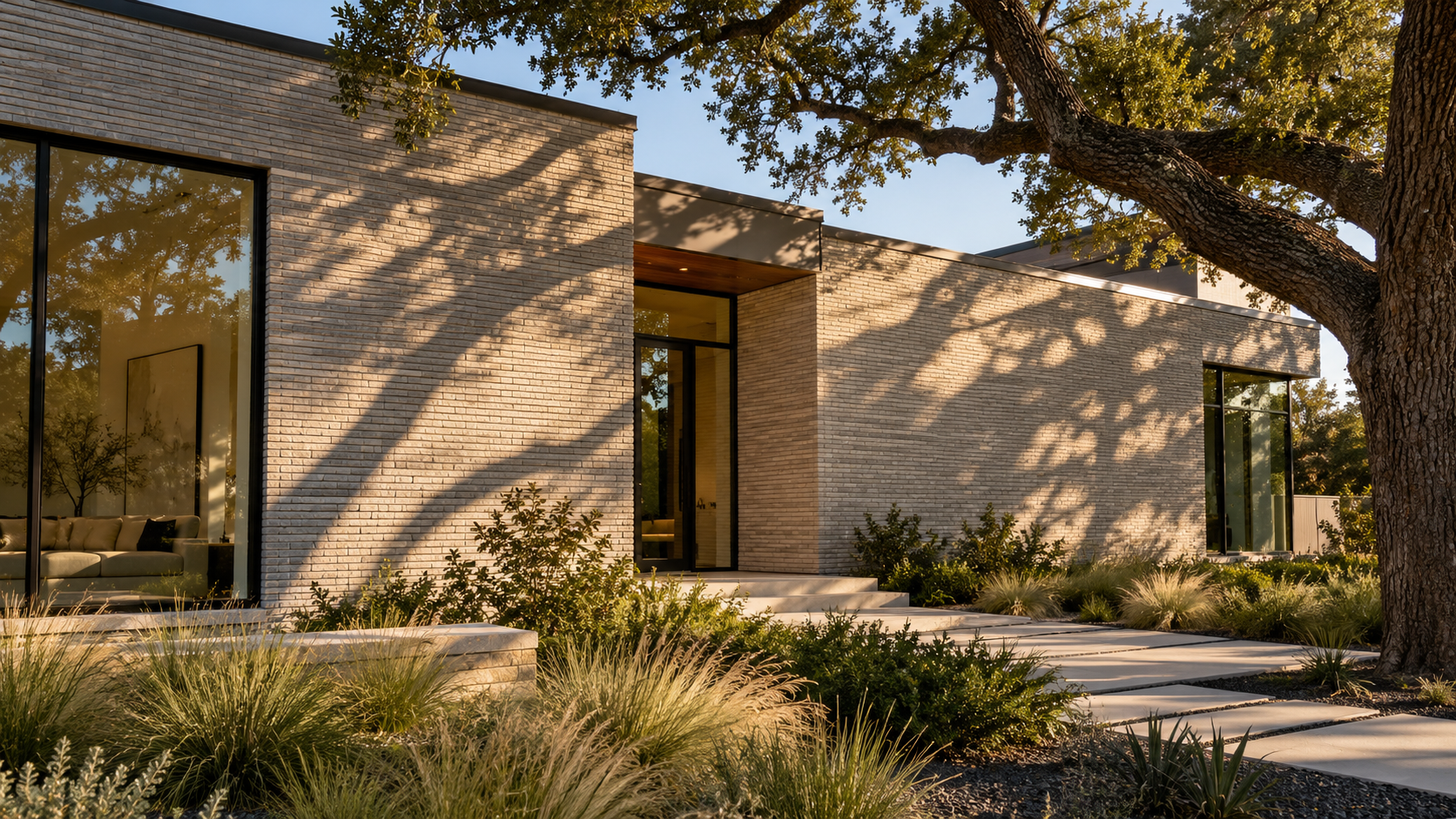
The best exterior cladding for a custom home is the one that matches the architecture and is detailed to manage water. Brick wins on durability and low maintenance, stucco on seamless modern form, and fiber cement on versatility and cost.
Cladding is the largest visible surface on a house, and it is chosen early, often before anyone has drawn a window. We treat it as a design decision and a building-science decision at the same time, because the prettiest wall in the world still fails if water gets behind it and cannot get out.
Key Takeaways
- No cladding is waterproof on its own; the drainage plane and flashing behind it matter as much as the material you see.
- Brick is the long-life, low-maintenance choice and suits traditional, Texas vernacular, and soft-modern homes.
- Stucco reads as a clean, continuous plane but needs a drained system and careful crack control.
- Fiber cement delivers board-and-batten, lap, or panel looks at a lower cost, with repainting every 10 to 15 years.
- Many of our best facades use one primary cladding and one accent, not three competing ones.
Brick: The Long Game
Brick veneer is a single layer of masonry tied to the frame with an air gap behind it. That gap is the secret: water that passes through the brick drains down and out through weep holes at the base. Done right, brick asks almost nothing of you for decades.
The look is broader than people assume. A long, thin Roman-format brick laid with a raked joint feels modern. A tumbled, limewashed brick feels old Texas. Mortar color alone can change the house more than the brick does.

Where brick costs more
Brick needs a foundation ledge to sit on and a mason to lay it, so it usually costs more upfront than siding. It is also heavy, which limits how it can be used on upper floors or cantilevers without steel support.
Stucco: The Clean Plane
Nothing gives a modern house that crisp, monolithic look like stucco. It wraps corners without seams, takes curves and arches easily, and comes in integral colors that never need paint.
Its reputation problems come from detailing, not the material. Stucco applied directly over sheathing with no drainage gap traps moisture, and that is where the horror stories start. We specify a drained assembly: a weather-resistive barrier, a drainage mat or furring, and weep screed at the base, with control joints placed deliberately so cracks land where we chose.

Fiber Cement: The Versatile Middle
Fiber cement is a board made of cement, sand, and cellulose. It comes as lap siding, vertical board-and-batten, shingles, or large smooth panels, and it does not rot, burn easily, or feed termites. For a farmhouse, coastal, or Hill Country modern design, it often delivers the look at the best value.
The tradeoffs are paint and joints. Factory finishes last longer than field paint, but expect repainting every 10 to 15 years. Panel systems also need a planned joint layout, or the seams end up wherever the installer runs out of board.

What Changes in Houston
Our humidity and rain push the decision toward assemblies that dry. In Houston, Fulshear, and Brazoria County we favor a real air gap behind any cladding, generous roof overhangs to keep walls dry, and a base course of brick or stone in the splash zone. Coastal sites add wind-driven rain and salt, which favors masonry and factory-finished fiber cement over field-painted products.

Wondering how a mix would look on your lot? Start a conversation with the studio and we will sketch the options side by side.
Frequently Asked Questions
Which exterior cladding lasts the longest?
Brick. A well-built brick veneer can outlast the rest of the house with little more than occasional joint repair. Stone is similar. Stucco and fiber cement last decades too, but they need sealing or paint along the way.
Is stucco a bad idea in a humid climate?
Not when it is drained. Problems come from stucco applied tight to the wall with nowhere for water to go. A drainage gap and proper weep screed make it a reliable choice.
Can I mix brick and siding on one house?
Yes, and it often looks best that way. Pick one main material and one accent, and change materials at an inside corner or a clear break in the massing, never in the middle of a flat wall.