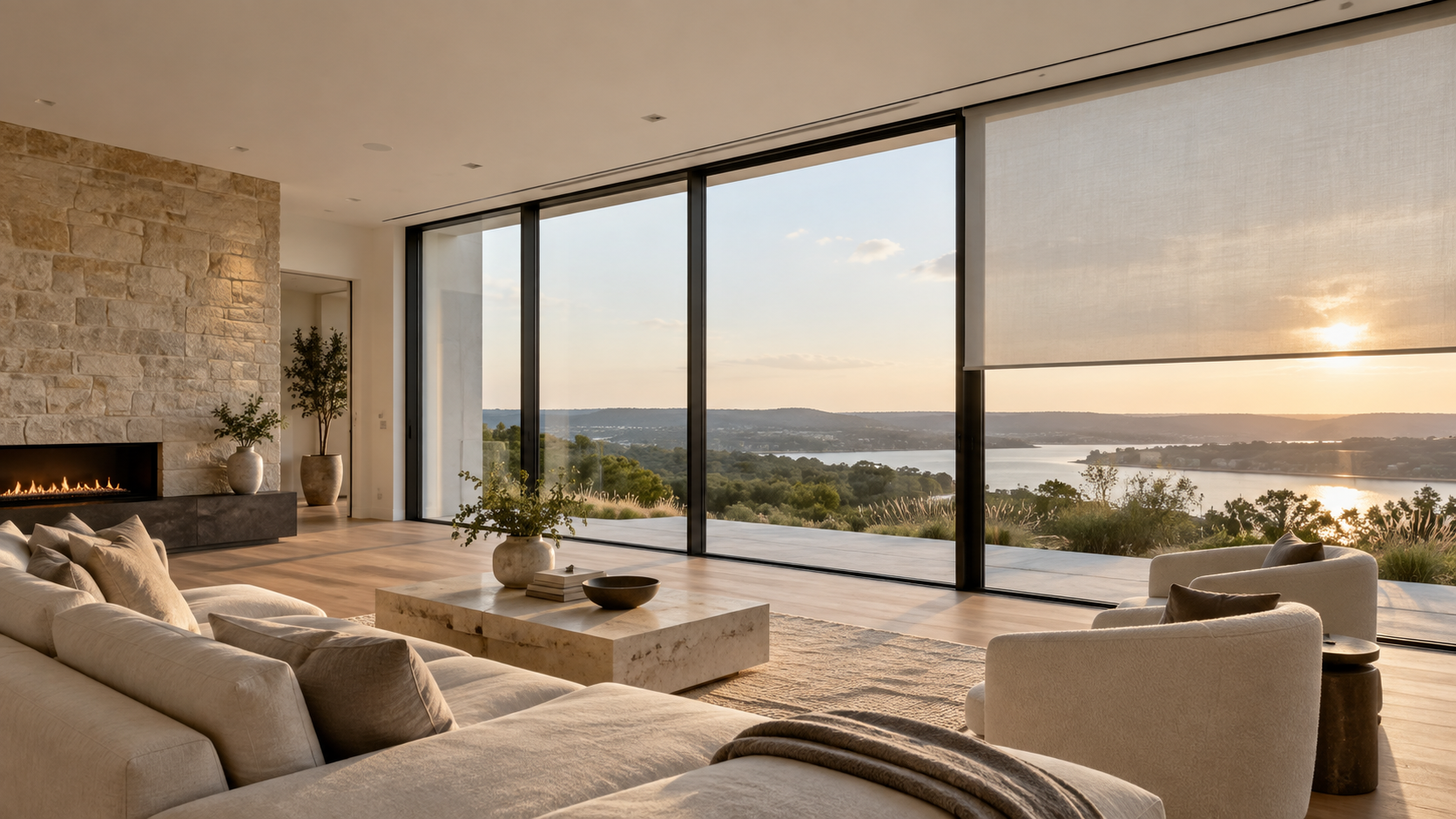
The cleanest window treatments in a custom home are designed during framing, not shopped for after move-in. When the studio plans recessed shade pockets, ceiling drapery tracks, wood blocking, and power at each window early, the hardware disappears and the glass reads the way the architecture intended.
Most homeowners think about shades the month before they move in. By then the ceilings are closed, the window heads are finished, and the only option left is a bracket screwed to the trim with a visible housing on top. That is the moment a carefully detailed window starts to look like an afterthought.
Key Takeaways
- Decide on window treatments during design development, before framing starts.
- Recessed shade pockets hide the roller and motor so a raised shade vanishes into the ceiling.
- Ceiling-mounted drapery tracks make windows feel taller and let fabric stack clear of the glass.
- Every motorized window needs power or a battery plan, plus solid blocking behind the drywall.
- In hot, bright climates, solar shades on the west and south do real work on glare and heat.
Why Window Treatments Belong in the Drawings
A window treatment is part of the wall, not a decoration hung on it. The depth of the head, the height of the ceiling, and the location of the nearest outlet all decide what kind of shade or drapery can go there. Once those are built, the choice narrows to whatever fits.
Planning early also changes what the window itself can be. If we know a room will use full-height drapery, we can carry the glass right to the ceiling and let the fabric frame it. If a room needs blackout, we can design a pocket and side channels that actually block light instead of leaking it around the edges.
Recessed Shade Pockets
A shade pocket is a slot built into the ceiling or soffit just inside the window. The roller, fabric, and motor sit up in that slot, so when the shade is raised you see a clean ceiling line and a thin reveal, nothing more. It is the single detail that most separates a finished custom home from a standard one.

What a Pocket Needs
Most pockets run about five to seven inches deep and wide, depending on the fabric and whether two shades share one slot. A double pocket holds a sheer and a blackout together, which is common in primary bedrooms. The pocket has to clear ceiling joists, ducts, and recessed lights, which is exactly why it has to be drawn before framing.
Drapery Tracks and Ceiling Mounts
Drapery hung from a ceiling track makes a window look taller and a room feel more finished. Mounting at the ceiling rather than just above the window head lets the fabric fall in one uninterrupted line. A recessed track, set flush in the drywall, removes the rod entirely.
We also plan where the drapery stacks when it is open. A stack needs wall space beside the glass, often ten to twenty inches per side for full-height panels. If that space is not there, the fabric covers part of the window you paid for.

Power, Blocking, and Controls
Motorized shades are now the default in most of the homes we design, and they depend on decisions made behind the drywall. Each hardwired shade needs a low-voltage or line-voltage feed at the head. Battery shades skip the wiring but still need a plan for reaching them to recharge.
- Blocking: solid wood framing behind every bracket so heavy drapery and long shades stay level.
- Wiring: power run to each shade location, grouped by room, before insulation goes in.
- Controls: keypads placed with the light switches, plus scenes tied to the lighting and smart-home system.
- Access: a removable panel or open pocket so a motor can be serviced without cutting drywall.
Houston Sun: Where Shades Do Real Work
In Houston and across the Gulf Coast, the west and south windows take the hardest sun. A solar shade with the right openness factor, often three to five percent, cuts glare and heat while keeping the view. We pair that with deep overhangs and good glass, so the shade finishes the job rather than doing all of it.

Media rooms, nurseries, and primary bedrooms need blackout with side channels. Living spaces usually want a sheer or solar layer that stays down much of the day. Planning which rooms get which layer lets the whole house read consistently from the street.
If you are early in planning and want treatments designed in from the start, start a conversation with the studio.
Frequently Asked Questions
Can shade pockets be added after the house is built?
Sometimes, but it means opening finished ceilings and working around joists and ducts. A surface-mounted fascia or valance is the usual fallback. Designing the pocket during framing costs far less and looks cleaner.
Are motorized shades worth it in a custom home?
For tall windows, hard-to-reach glass, and rooms tied to a daily routine, yes. Think of it like power windows in a car. You stop noticing them, and you never want to go back.
When should we choose window treatments?
Decide the type for each window during design development, before framing. Fabrics and colors can wait until finishes are selected. The structure has to be settled early.