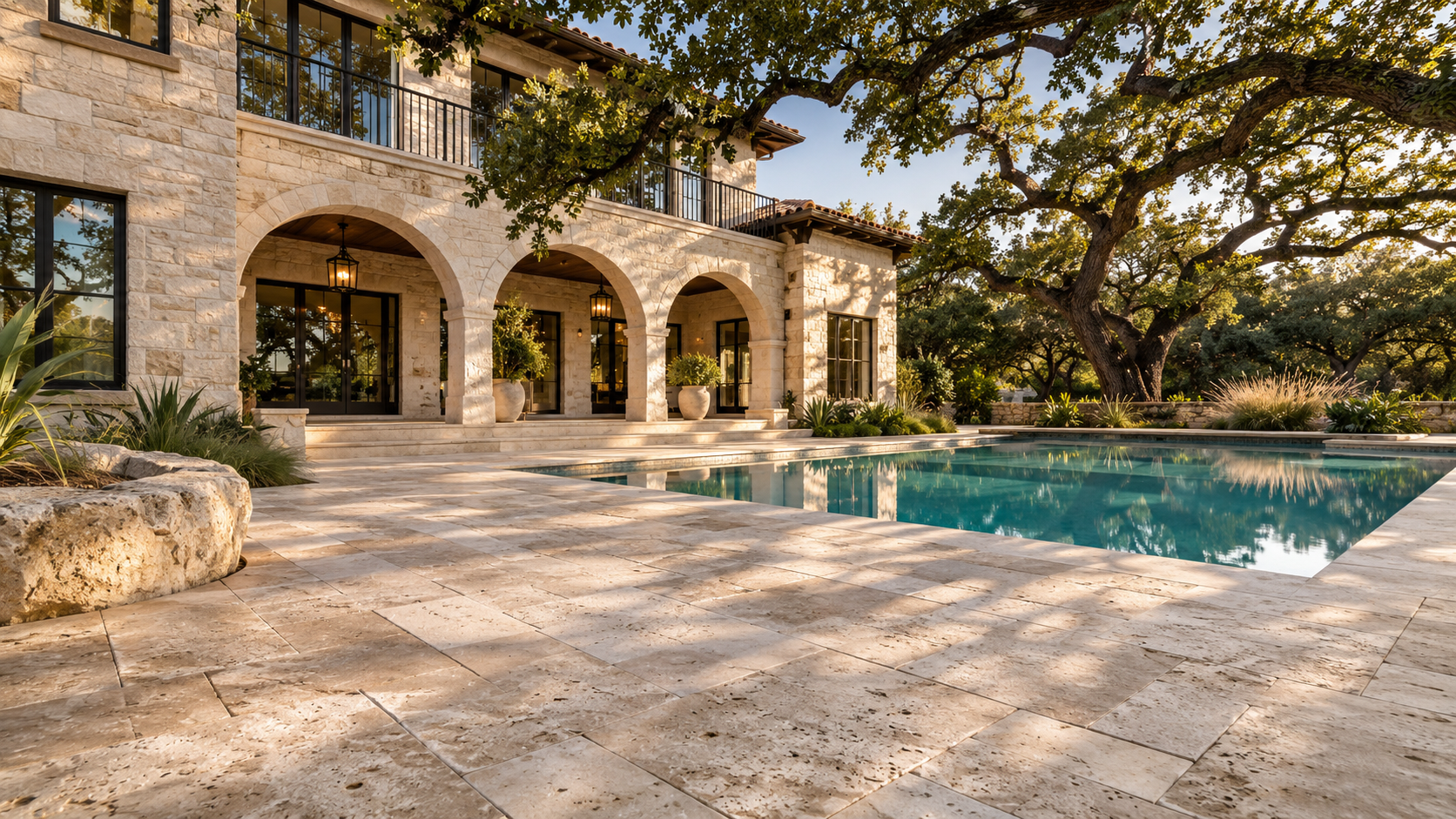
The best patio surface for most custom homes comes down to three choices: travertine if the patio sits in full sun or wraps a pool, porcelain pavers if you want a clean look and almost no upkeep, and concrete if budget matters most and the soil is stable. Each one behaves differently in heat, rain, and time, so the choice belongs in the design, not at the end of construction.
As home design experts, we treat the patio as a room with a floor, not as leftover concrete behind the house. The surface decides how hot it feels at 4 p.m. in August, whether a dropped glass of juice stains it, and how cleanly it lines up with the living room floor inside.
Key Takeaways
- Travertine is porous and light, so it stays cooler under bare feet and grips well when wet. It needs sealing.
- Porcelain pavers absorb almost no water, shrug off stains and mildew, and come in large, thin slabs that read as indoor flooring carried outside.
- Cast-in-place concrete is the lowest first cost, but on expansive clay it cracks unless joints, reinforcing, and drainage are designed for it.
- Pavers set on a compacted base flex with moving soil; rigid slabs do not.
- Plan the slope, the drain, and the threshold height before choosing the material.
Travertine: The Cool, Classic Choice
Travertine is a natural limestone full of tiny pores. Those pores let it shed heat faster than dense stone, which is why it is the go-to surface around pools. A tumbled, unfilled finish gives good grip when wet, and its soft ivory and walnut tones fit Mediterranean, Spanish, and warm modern houses alike.

Where travertine falls short
Those same pores soak up oil, rust, and leaf tannins if the stone is left unsealed. Plan on a penetrating sealer every two to three years. Avoid filled, honed travertine outdoors: the filler pops out after a few freeze-and-thaw or heat cycles and leaves small holes.
Porcelain Pavers: Indoor Flooring, Carried Outside
Outdoor porcelain pavers are usually about 3/4 inch thick and fired so dense they absorb less than half a percent of their weight in water. That means no sealing, no mildew in the grout lines, and no stains from a grill or a spilled drink. They come in large formats like 24 by 48 inches and in looks that copy limestone, concrete, and wood.
The real advantage is continuity. Our design experts often run the same porcelain series inside the living room and out across the patio, in matching size and joint lines, so a wall of sliding glass doors disappears when it opens. Pick a textured outdoor finish with a wet slip rating suitable for exterior use, not the smooth indoor version of the same tile.

Where porcelain falls short
Dark porcelain gets hot in direct sun, so keep the darker tones under a roof. It also chips if a heavy pot is dropped on a corner, and it needs a flat, well-built base, whether that is a mortar bed on a slab, a compacted gravel base, or adjustable pedestals on a roof deck.
Concrete: Budget-Friendly, With Conditions
Poured concrete is the least expensive patio surface and can look refined: a fine broom finish, a sandblasted texture, or exposed aggregate with small river stones. It suits modern and farmhouse houses that want a plain, monolithic ground plane.
The catch is cracking. Concrete shrinks as it cures and moves with the soil, so it needs control joints spaced roughly every 8 to 10 feet on a typical 4-inch slab, plus steel reinforcing. A good joint layout is drawn, not left to the finisher, so the joints line up with columns, doors, and the edges of planting beds.

The Houston Factor: Clay Soil, Heat, and Rain
Around Houston, Fulshear, and Brazoria County, expansive clay swells when wet and shrinks in drought. A rigid slab can crack or tilt toward the house over a few seasons. Pavers set on a compacted gravel base handle that movement better because each unit can shift slightly without breaking, and a single settled paver can be lifted and reset.
Whatever you choose, slope the patio about 1/4 inch per foot away from the house and give big rains somewhere to go: a trench drain at the door, or a planted edge that takes the runoff. Remember too that most cities count patios toward impervious cover, even pavers on sand, unless the system is a true engineered permeable paver. That limit can decide how big the patio is allowed to be.
How We Help Clients Decide
We start with the house, not the sample board. A pool deck in full sun points to travertine. A covered patio that continues the living room points to porcelain. A large, simple terrace on a tight budget can be concrete, if the soil report and the joint plan support it. Many of the best patios mix two: porcelain under the roof, travertine or gravel beyond it. If you are weighing these options for a new house, start a conversation with the studio and our expert design team will match the surface to your site.
FAQ
Which patio surface stays coolest in the Texas sun?
Light, porous travertine stays the coolest underfoot. Light-colored porcelain comes next. Dark porcelain and dark stained concrete get the hottest, so keep them in shade.
Are porcelain pavers slippery when wet?
Not if you choose an outdoor-rated, textured finish. The same tile in a smooth indoor finish can be slick, so check that the product is rated for wet exterior use.
Is concrete or pavers better on clay soil?
Pavers on a compacted gravel base cope with moving clay better than a rigid slab, and repairs are simpler. Concrete can work, but it needs reinforcing, planned joints, and good drainage.
Should the patio be level with the indoor floor?
A flush threshold looks seamless, but it needs a trench drain at the door and a covered patio to keep rain out. Without both, step the patio down a little below the interior floor.