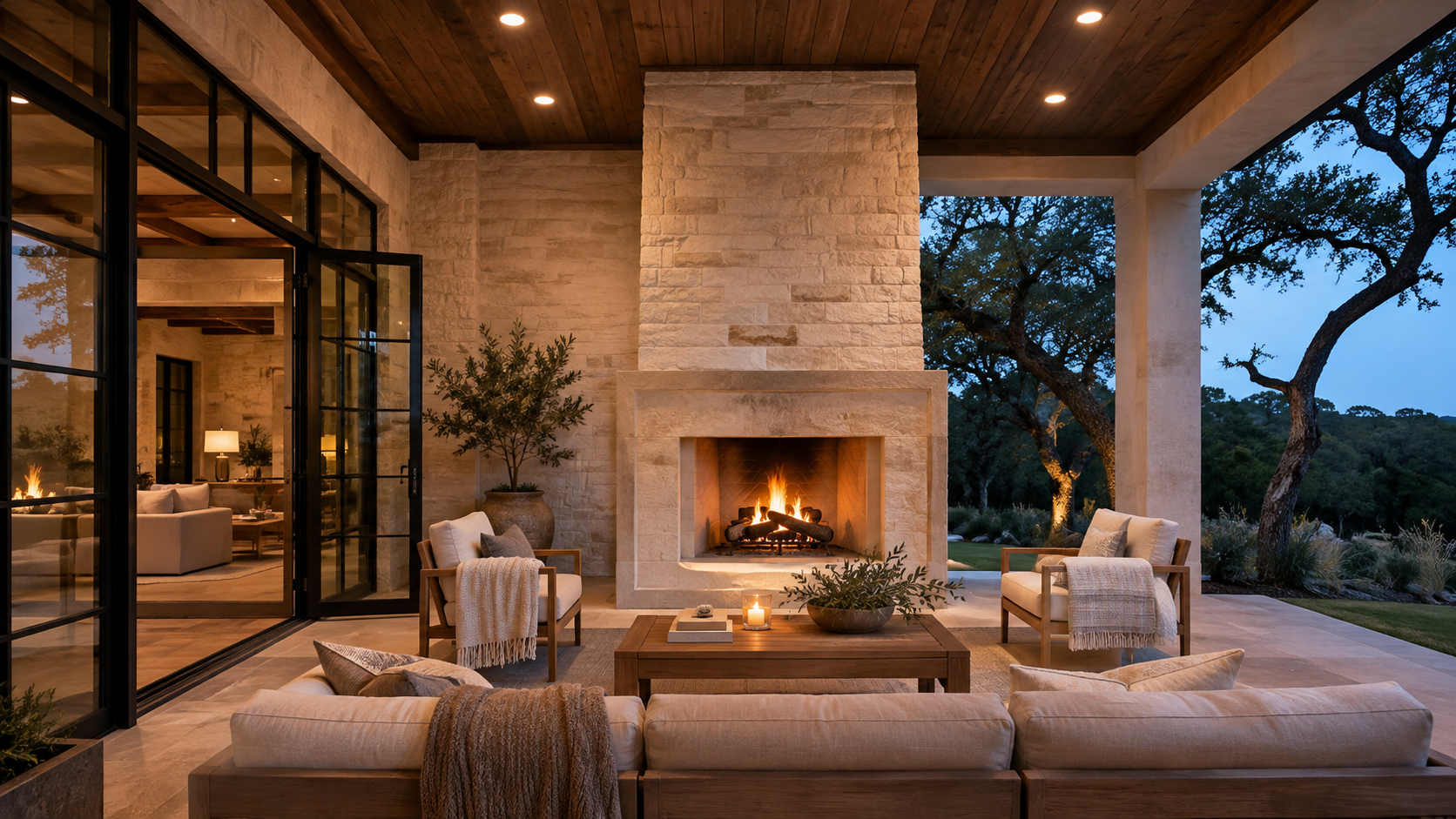
An outdoor fireplace or a fire pit: the right choice depends on how you gather and where the fire sits. A fireplace suits a covered patio or outdoor room, where it anchors one wall and pushes smoke up a chimney. A fire pit suits an open terrace, where people circle the flame and the smoke drifts off into open sky.
Both look good in a photo. The difference shows up on the third cold evening, when you notice whether people actually go outside. As custom home design experts, we treat the fire feature as part of the floor plan, not a garden accessory picked at the end, because its location decides how the whole outdoor space gets used.
Key Takeaways
- A fireplace creates a focal wall and a sheltered, room-like seating group; a fire pit creates an open circle for conversation.
- Fires under a roof almost always mean a fireplace with a chimney, or a gas unit rated for covered use.
- Gas is easier to permit, cleaner and instant; wood gives the crackle and smell but needs flue height, clearances and ash cleanup.
- Plan gas lines, wind direction, seating distance and setbacks during design, not after the patio is poured.
How Each One Shapes the Way People Gather
A fireplace sets up seating that faces one direction, the same way a living room arranges itself around a hearth. That makes it ideal for a covered patio next to an outdoor kitchen or dining table: the fire becomes the backdrop, and the mass of the firebox and chimney can screen a neighbor's window or block a prevailing wind.
A fire pit does the opposite. Chairs ring it, everyone faces everyone, and the conversation runs across the flame. It belongs out in the open, often a few steps down from the main patio or at the end of a garden path, where it becomes a destination rather than part of the house.

Under a Roof or Under the Sky
This is the question that settles most projects. An open flame under a patio roof traps smoke and heat against the ceiling, so a covered space needs either a fireplace with a properly sized chimney or a gas appliance listed for covered installation, with the clearances its maker specifies.
A fire pit wants open sky above it and room around it. Keep it well clear of roof edges, overhangs, trees and the house, and set it far enough from any property line to satisfy your city and HOA. Our design experts check this early, because a masonry fireplace with a chimney is a structure, and it may have to sit inside the same lines as the house. If you have never looked at those limits closely, this guide on how a building setback is measured from the property line is a good place to start.
Wind and smoke
Before placing either feature, look at which way the evening breeze runs across the lot. Put the fire downwind of the seating, never upwind of the back door or the outdoor kitchen. In much of the Houston area the summer breeze comes from the south and southeast, while cool fall and winter evenings often bring a north wind, which is exactly when you will use the fire most.
Gas or Wood?
Gas starts with a switch, burns clean, leaves no ash and is usually simpler to approve under covered patios and in deed-restricted neighborhoods. The trade-off is a quieter, more uniform flame and a gas line that must be planned before any concrete is poured.
Wood gives you the crackle, the smell and real radiant heat. It also needs a code-compliant firebox and a chimney tall enough to draw well, a place to store dry wood, and a clear path to haul ash away. Some families split the difference: a wood fireplace on the covered patio for winter weekends, and a gas fire table on the open terrace for quick weeknight use.

Sizing and Seating Distances
A fire pit around 36 to 48 inches across, with an interior bowl sized to the fuel, comfortably serves six to eight people. Leave roughly 5 to 7 feet from the edge of the fire to the front of the seats so people feel the heat without being cooked, plus a walking path behind the chairs.
Outdoor fireplaces read best when they are scaled to the space around them. A firebox opening in the range of 36 to 48 inches wide suits most covered patios, and the chimney breast should run the full height of the wall so it looks built rather than added. Raised hearths around 12 to 18 inches high double as extra seating.
What It Takes to Build Each One
A gas fire pit or fire table is the lighter lift: a gas line, a burner, a fire-rated surround and a level pad. A masonry outdoor fireplace needs a real footing under its weight, a structural connection to any roof it passes through, flashing where the chimney meets that roof, and a spark arrestor cap. That is why it belongs on the drawings from the first sketch of the outdoor room.

Frequently Asked Questions
Can I put a fire pit under a covered patio?
Usually not a traditional open fire pit. Smoke and heat collect under the ceiling. Under a roof, use a fireplace with a chimney or a gas fire table rated for covered use, installed with the ceiling clearances the maker requires.
Which costs more, an outdoor fireplace or a fire pit?
A fire pit almost always costs less. A built masonry fireplace with a footing and chimney is closer to building a small piece of the house, so it sits at the higher end of the budget.
Is one better for resale?
Both add appeal, but a well-placed fireplace on a covered patio reads as part of the architecture, while a fire pit reads as part of the landscape. The best value comes from the one your family will actually use.
Plan the Fire With the House
The best outdoor fire features feel like they were always meant to be there, because they were drawn with the rooms around them. With expert guidance, the fireplace, the fire pit, the gas line and the seating all land in the right place the first time. When you are ready to plan your outdoor rooms, start a conversation with the studio.