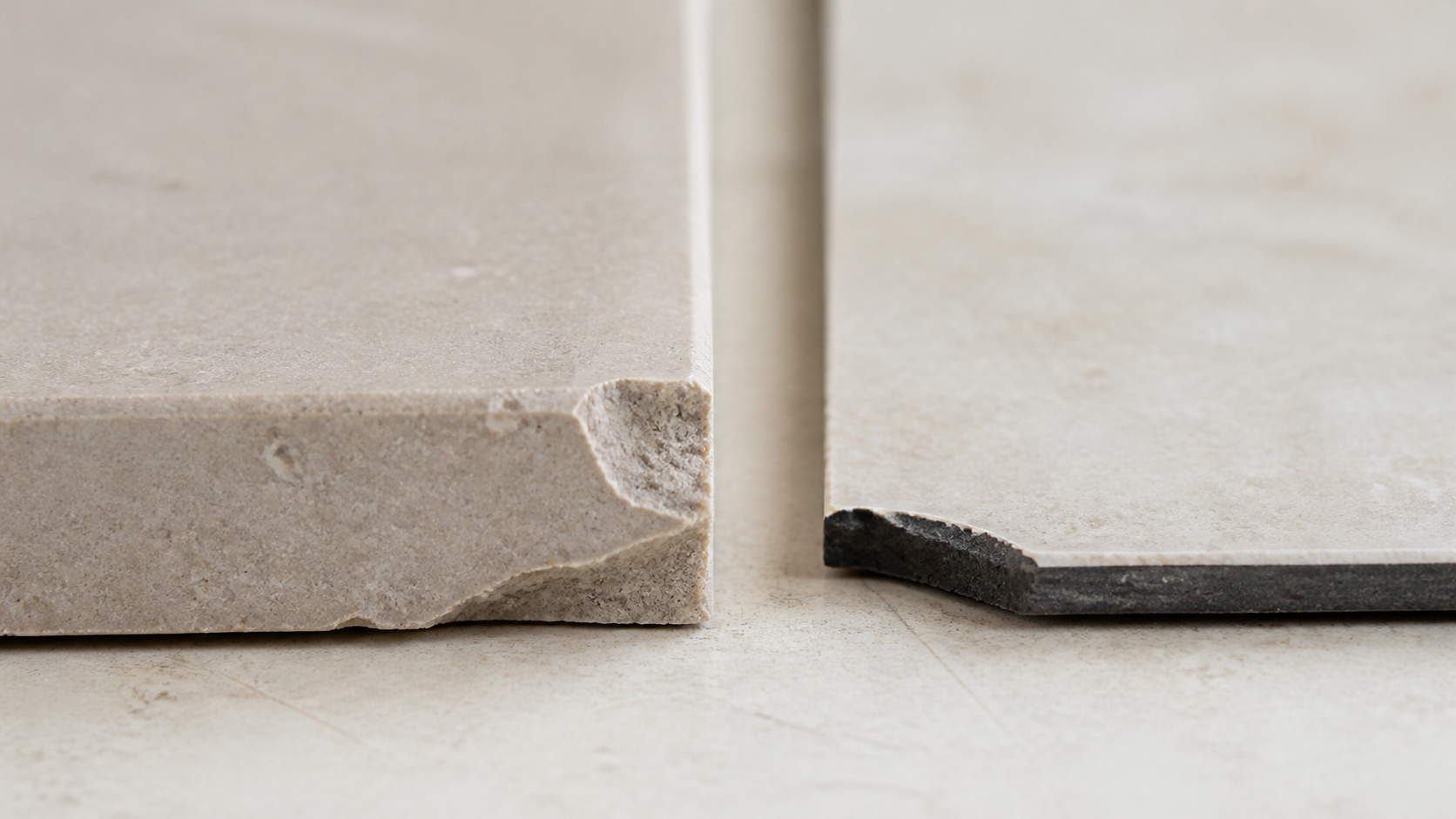
A material ages well when wear reads as character rather than damage. Solid brass, unlacquered copper, honed limestone, white oak, lime plaster, terracotta, and quarter-sawn timber all darken, soften, or patina in ways that make a room feel older and better. Thin veneers, high-gloss lacquers, engineered coatings, and anything printed to imitate a natural surface do the opposite: they look their best on day one and decline from there.
We spend a surprising amount of a project's material conversation on this single question — not what does it look like now, but what will it look like in twelve years, with a family living on it.
Key Takeaways
- Materials with color and texture running all the way through — stone, solid wood, solid metal, plaster — hide wear. Surface-applied finishes advertise it.
- Patina is oxidation, abrasion, and UV working on a real material. Damage is a coating failing on top of a substrate.
- The finish matters more than the material: an unlacquered brass pull ages beautifully, the same pull under clear lacquer flakes in five years.
- Budget for maintenance rituals — oiling, waxing, resealing — the way you budget for the material itself.
- Mix aging and stable materials on purpose so the house changes at a controlled pace rather than all at once.
Through-Body Versus Skin-Deep
The most reliable test we apply is simple: cut the material in half and see whether the inside matches the outside. Solid walnut, honed marble, brick, solid brass, and lime plaster are consistent all the way through, so a scratch or a chip exposes more of the same thing. A scuff becomes texture.
Skin-deep materials — laminate over particleboard, powder-coated aluminum, thin porcelain printed to look like travertine, PVD-finished hardware — are two materials pretending to be one. When the skin wears through, the illusion breaks in a single visible spot, and the only repair is replacement.

The Metals That Earn Their Keep
Unlacquered brass is the clearest example of a material that improves with handling. Left bare, it oxidizes to a warm brown, then keeps polishing itself bright exactly where hands touch it — around a faucet lever, along a cabinet pull. The house records how it is used.
Where we use bare metal
Faucets, pulls, hinges, and rail caps. Anywhere the client is willing to accept an uneven, living finish. We are direct about this in the specification stage, because a homeowner expecting uniform gold will read the first month of oxidation as a defect.
Where we do not
Anything the client wants to look identical in a decade — most often a statement stair rail or a large expanse of exterior metal directly above stone, where copper runoff can stain what sits below it.

Wood, Stone, and Plaster: The Slow Three
White oak floors finished with a penetrating hardwax oil rather than a film-forming polyurethane can be spot-repaired forever. A scratch gets cleaned, oiled, and buffed in an afternoon. A polyurethane scratch waits for the day the whole floor is sanded.
Honed and leathered stone hides etching and water marks that would be obvious on a polished slab — which matters enormously on a kitchen island that will meet citrus and red wine vinegar. Lime plaster and mineral paint absorb light unevenly by nature, so the small imperfections a family adds simply join the ones the trowel left.
Choose the finish that can be repaired in place. Almost every material that ages badly is one that can only be replaced, never mended.

The Gulf Coast Correction
Humidity changes the answer. In Houston and along the Gulf Coast, the aging curve is steeper: sustained high moisture and salt-carrying air accelerate oxidation, and wide solid-wood assemblies move seasonally more than they do in a dry climate.
In practice that means we detail exterior wood with generous overhangs and back-ventilated rainscreens rather than sealing it tight, favor thermally modified or naturally durable species outdoors, and keep untreated ferrous metals off any elevation that takes wind-driven rain. Indoors we let humidity work for us — plaster and stone are indifferent to it. If you want to talk through material selections for a specific site, start a conversation with the studio.

Maintenance Is Part of the Specification
Materials that age well are not maintenance-free — they are maintenance-forgiving. The difference is that the work is small, repeatable, and optional in timing.
- Oiled floors: refresh high-traffic paths every 12 to 24 months, full recoat roughly every five years.
- Bare brass and copper: nothing, unless you want it bright — then a paste polish on the pieces you care about.
- Honed stone counters: reseal annually with a penetrating impregnator, and accept some etching as part of the finish.
- Lime plaster: dust and touch up locally; the material re-carbonates and hardens over years.
- Thermally modified exterior wood: leave it to gray, or oil it every two to three years to hold color.
Frequently Asked Questions
Do materials that patina hurt resale value?
Not in the segment we work in. Buyers reading a house as high-end respond to real stone, real wood, and real metal even when worn — what reads as cheap is a synthetic surface that has failed. The risk is not patina; it is a buyer who expected a factory finish and received a living one, which is a disclosure and photography issue more than a value one.
What is the single best-aging material for a busy family kitchen?
Honed or leathered quartzite for counters and rift-sawn white oak with a hardwax oil for cabinetry and floors. Both take real abuse, both can be repaired locally, and neither has a coating that can fail as a layer.
Can we mix aging materials with stable ones?
Yes, and we usually do. A common approach is stable materials on the large planes — porcelain in a wet room, stable engineered cabinetry boxes behind solid fronts — with the aging materials placed where hands and eyes actually land. You can see how that plays out across finished work in our portfolio.
How early do these decisions need to be made?
Earlier than most people expect. Whether a floor is oiled or coated, whether hardware is bare or lacquered, and whether siding is ventilated changes framing depths, substrate choices, and trade sequencing — so these belong in design development, not at a late finish meeting.
The houses that look best at fifteen years are rarely the ones that photographed best at month one. Designing for patina is a decision to let a house keep a record of the life inside it — and to choose the materials honest enough to do that gracefully.