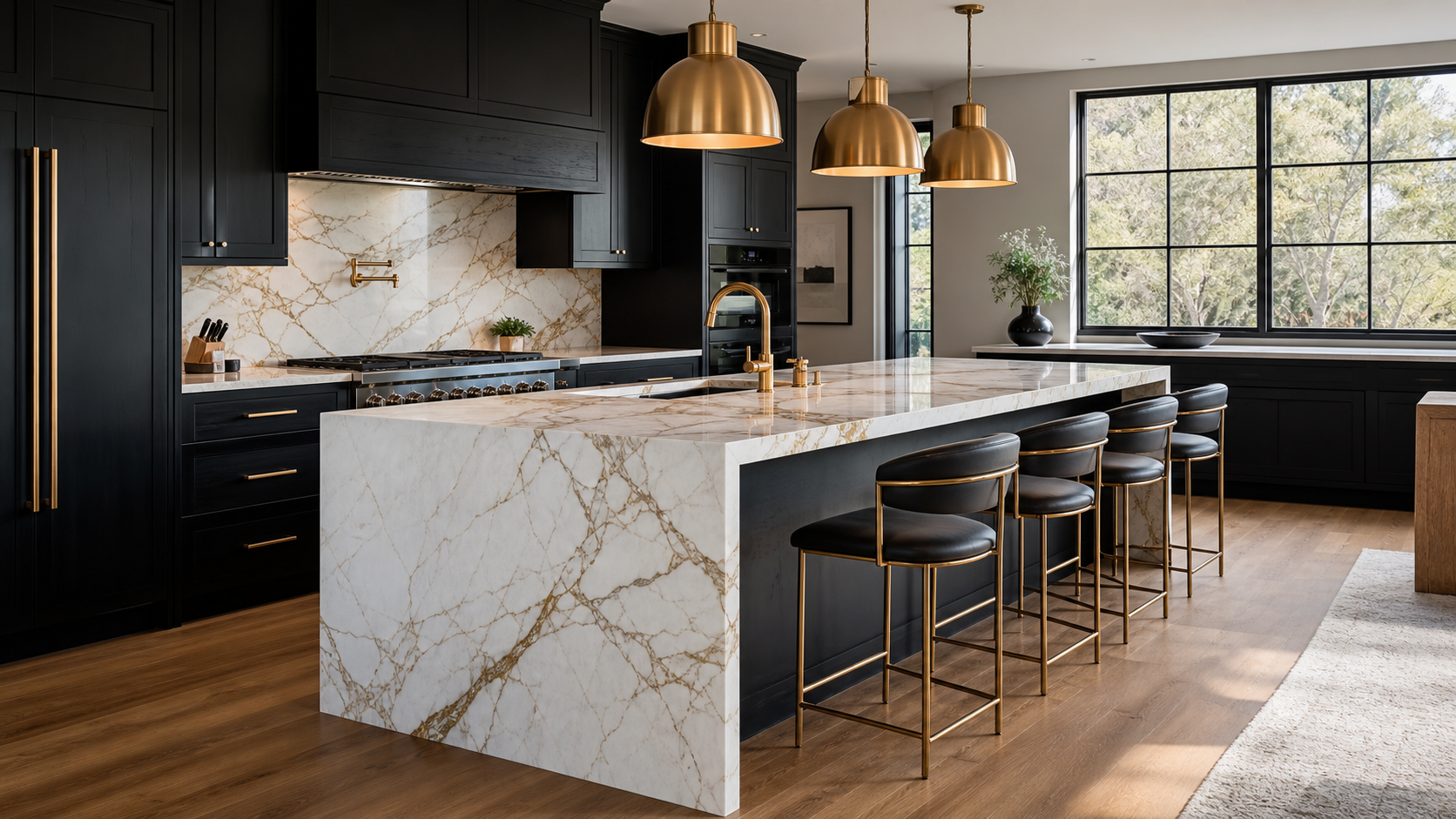
The kitchen island that carries its stone straight down to the floor — no seam, no cabinet reveal, just one continuous sheet of veining — is the single most requested feature we're hearing from clients heading into 2026. It's called a waterfall island, and the material driving it is quartzite: the look of marble with the everyday toughness of granite.
Why Waterfall Islands Are Everywhere Right Now
A waterfall edge extends the countertop material down one or both sides of the island to the floor, turning a work surface into a piece of furniture. Paired with bold veining, it reads as a single carved slab rather than a countertop, which is exactly the quiet-luxury effect homeowners across Houston, Sugar Land, and Fulshear are asking for: considered, calm, built to last.
- Quartzite delivers marble's veining with granite-level scratch and heat resistance
- Taj Mahal quartzite — warm beige with wispy white veining — is the standout 2026 variety
- Waterfall edges work in quartzite, marble, granite, and porcelain, with bold veining reading best
- Thicker slabs (1.5" to 2") read as more substantial and pair well with waterfall edges
- Calacatta-style veining against matte black or matte beige cabinetry is the dominant 2026 pairing
Quartzite vs. Marble vs. Limestone: Picking the Right Stone
These three stones get grouped together because they share a soft, veined, natural look — but they perform very differently in a working Texas kitchen. Getting this choice right at the design stage matters more than any finish decision made later.
Quartzite: The Workhorse of the Group
True quartzite is metamorphosed sandstone, harder than marble and largely resistant to etching from lemon juice, wine, or vinegar. Varieties like Taj Mahal, Cristallo, and Mont Blanc give you dramatic, marble-like movement without the babying. For a primary island that will see daily prep work, this is almost always our recommendation.
Marble: Still the Aspirational Choice
Calacatta Gold and similar marbles remain the benchmark for dramatic veining, and in 2026 they're increasingly paired with matte black cabinetry for a contrast that photographs beautifully. Marble etches and stains more readily than quartzite, so we tend to place it on a secondary surface — a wet bar, a powder room vanity, a butler's pantry — where the patina reads as character rather than damage.

Limestone: The Warm, Matte Alternative
Limestone brings a honed, matte texture and warmer tone than either marble or quartzite, and it's showing up on fireplace surrounds and interior accent walls as often as on countertops. It's softer and more porous, so we generally spec it for vertical, low-contact surfaces rather than a daily-use island top.
Designing the Waterfall Island Into the Floor Plan
A waterfall island isn't just a material choice — it changes the structural and layout planning underneath it. The panels need full slab support (not a plywood substrate with a stone veneer), the seam where two slabs meet has to be planned around the most dramatic vein movement in the block, and the surrounding cabinetry has to be quiet enough not to compete.
Slab Selection Is a Design Decision, Not an Afterthought
Because natural stone slabs vary piece to piece, we walk clients through slab selection at the yard before fabrication — laying out where the boldest veining lands on the waterfall face versus the work surface. This is one of the design details we walk through early when clients start a conversation with the studio, because it drives cabinetry, lighting, and even ceiling height decisions around the kitchen.

Why This Matters for Houston Homes Specifically
Humidity and heat make material performance a bigger consideration here than in drier climates. Quartzite's low porosity and resistance to thermal shock make it well suited to open-plan kitchens that flow into covered outdoor kitchens, a layout we design constantly for clients in Houston, Sugar Land, and Fulshear. Marble and limestone still have a place in these homes — just placed where their softness is a feature, not a liability.
Frequently Asked Questions
Is quartzite more expensive than marble?
Premium quartzite varieties like Taj Mahal or Cristallo often cost similarly to or slightly more than mid-range marble, mainly because of scarcity and fabrication difficulty. Budget should follow the slab you fall in love with, not a blanket rule about which stone costs less.
Can I get a waterfall edge on any stone?
Technically yes, but it looks best on stones with strong, continuous veining — quartzite, marble, and select granites. A busy, uniform pattern with no directional movement tends to look flat once it wraps the corner.
How do I keep a marble waterfall island from staining?
A quality penetrating sealer applied at installation and reapplied annually handles most day-to-day spills. For families who cook heavily with acidic ingredients, we usually steer the primary work surface to quartzite and reserve marble for a lower-contact panel or bar area.
Does a waterfall island work with a smaller kitchen?
Yes — a waterfall edge on a modest island can actually make the space feel more designed and intentional than a larger island without one. Slab layout and lighting matter more than square footage here.
The Bottom Line
The waterfall island isn't a passing trend so much as a return to treating the kitchen island as a piece of sculpture rather than a work surface. Quartzite gives most Houston households the durability to live with that sculpture daily; marble and limestone earn their place in the spaces where a little softness is the point. If you're planning a kitchen and want to see how these stones would actually read in your floor plan, see our portfolio for recent examples.