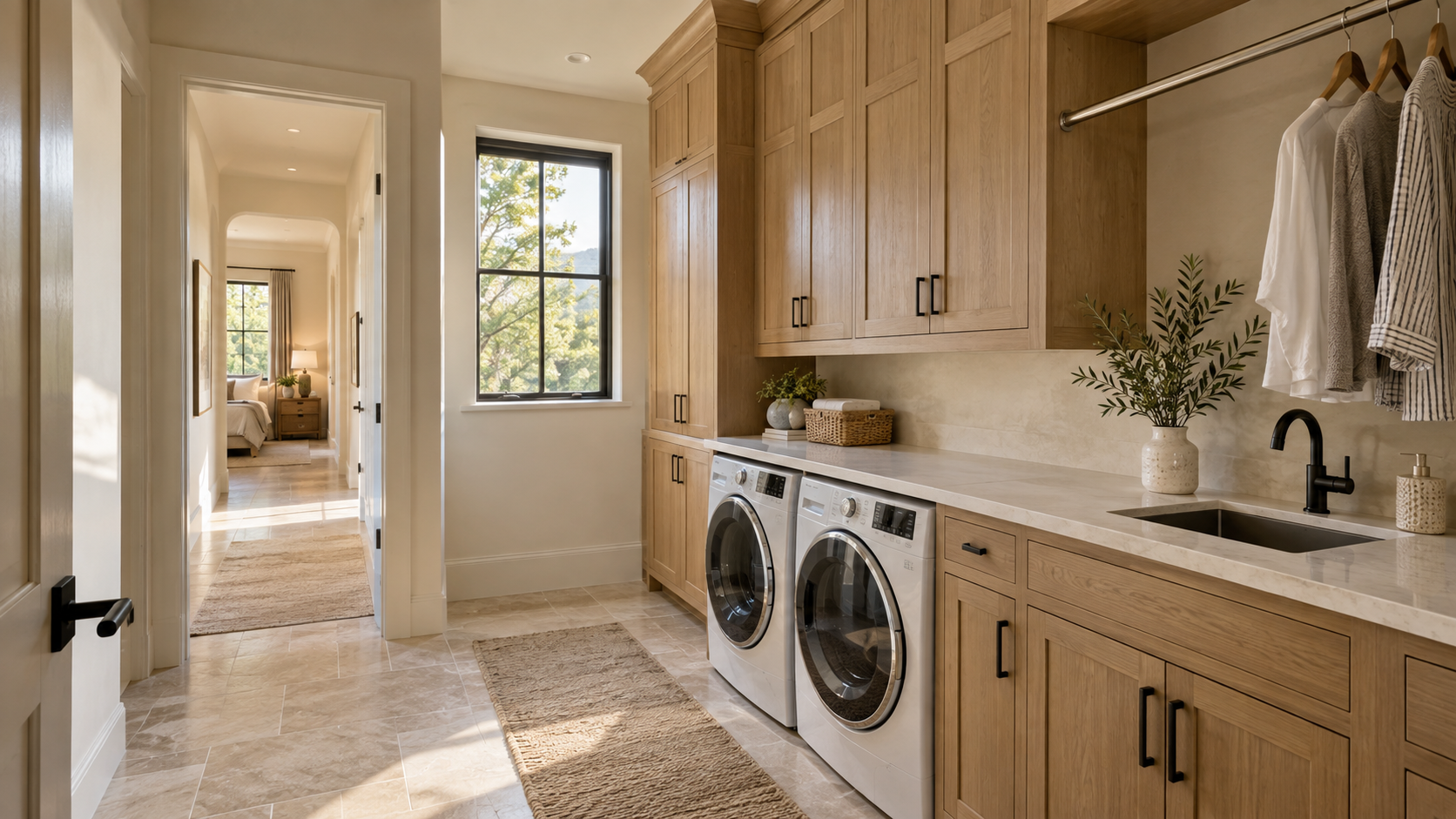
The laundry room belongs where the dirty clothes are made, which in most houses means on the bedroom floor and close to the closets. In larger custom homes, a second, smaller laundry near the garage, mudroom, or pool often pays for itself within the first year of living there.
Placement sounds like a preference. It is really a plumbing, venting, and leak-protection decision, and it is one of the few rooms where getting the location wrong costs you a trip up the stairs every week for as long as you own the house.
Key Takeaways
- Start from where laundry is generated and put away, not from where the plan has leftover space.
- A second laundry makes sense when a home has two distinct sources of wash: bedrooms upstairs, and pool towels, sports gear, or work clothes downstairs.
- A washer and dryer inside or beside the primary closet is the most convenient layout of all, and it needs the most careful leak and noise detailing.
- Upper-floor laundry needs a pan with a drain, an automatic water shut-off, and a short, straight dryer vent to an exterior wall.
- Size the room around the folding counter and the hanging rod, not just the two machines.
Start With Where the Laundry Actually Comes From
Follow a shirt through a normal week. It comes off in the bedroom, goes into a hamper in the closet, gets washed and dried, then gets folded or hung and goes straight back into that same closet. Every foot between the closet and the washer is a foot someone carries a basket, twice.
That is why we default to putting the main laundry on the bedroom level, off a shared hall and as close to the children's rooms and the primary suite as the plan allows. The old habit of putting it by the garage made sense when the garage was where the utilities lived. It does not make sense when every load starts and ends upstairs.

When a Second Laundry Is Worth It
A second laundry is not a luxury flourish in the right house. It is a response to a household that produces two kinds of wash in two parts of the home. The upstairs laundry handles clothes and bedding. The downstairs one handles pool towels, muddy sports uniforms, dog bedding, and anything you would rather not carry past the bedrooms.
The primary closet laundry
A stacked washer and dryer inside the primary closet, or in a small room between the closet and the bath, is the most requested feature we see in this category. Clothes go from hamper to machine to hanger in about ten steps. It works beautifully when the owners do most of their own laundry and the rest of the household is grown or gone.
The working laundry near the garage or pool
The second room can be modest: a side-by-side pair, a deep utility sink, and a floor that shrugs off standing water. We usually place it on the plumbing wall shared with the mudroom, so both rooms share one drain run and the wet traffic from the pool or the driveway never reaches the finished rooms.

Sizing the Room Around the Work, Not the Machines
Two machines side by side take roughly five feet of wall. That is the easy part. The room works or fails on everything around them: a folding counter at least as long as the machines, a rod for hang-dry items with open floor beneath it, a sink for stain treatment, and room in front of the front-loaders to bend down and pull wet laundry out without backing into a wall.
We plan the aisle in front of front-loading machines at about 42 inches, so an open door and a person kneeling in front of it can both fit. Top-loaders need less floor and more headroom above. If a stacked pair is the plan, we check the dryer controls sit within easy reach for everyone who will use it.
Upstairs Laundry Done Right: Leaks, Vents, and Noise
The fear with upper-floor laundry is a burst supply hose over a finished ceiling. The answer is detailing, not avoidance. Every upstairs washer we design sits in a pan piped to a real drain, gets a leak sensor tied to an automatic shut-off valve, and uses a recessed supply box so the hoses are not crushed behind the machine.
The dryer vent matters just as much. Building codes cap the length of a dryer duct and deduct length for every bend, because long, twisting runs trap lint and lint is a fire risk. We place the dryer on or near an exterior wall so the run is short and nearly straight, or we specify a ventless heat-pump dryer where no good route exists.

Noise is the last piece. A washer spinning over a bedroom is felt as much as heard. We avoid stacking laundry directly over a bedroom or office, frame the floor stiffer under the machines, and add sound insulation and a solid-core door to the room.
What Changes in a Houston-Area House
Gulf Coast humidity makes laundry a moisture problem as well as a plumbing one. A dryer vent must always discharge outdoors, never into an attic, where warm, wet air will condense on the roof deck. The laundry room itself needs exhaust or conditioned supply air so damp towels do not turn the room musty by August.
On a slab foundation, a ground-floor laundry is simple to plumb, which is why so many older Houston plans kept it downstairs. Upstairs placement means planning the drain and supply routes in the framing stage. That is easy on paper and costly after the drywall is up, so if you are still shaping a plan, start a conversation with the studio before the plumbing walls are set.
Frequently Asked Questions
Is an upstairs laundry room a good idea?
Yes, when it is detailed properly. With a drain pan, an automatic shut-off, and a short exterior dryer vent, an upstairs laundry is as safe as a downstairs one and saves a trip up the stairs with every load.
How big should a laundry room be in a custom home?
Plan on roughly 60 to 100 square feet for a main laundry with a folding counter, sink, and hanging rod. A secondary laundry or a closet laundry can work in 25 to 40 square feet.
Does a second laundry room add value?
In larger homes with a pool, active kids, or multiple generations, it usually does, because buyers in that bracket recognize the daily convenience. In a smaller plan, the space is often better spent making one laundry generous.
Put the laundry where the clothes live, add a second one only when the house truly makes two kinds of wash, and detail both for water. Get those three decisions right early and the laundry becomes one of the quiet reasons a house is easy to live in.