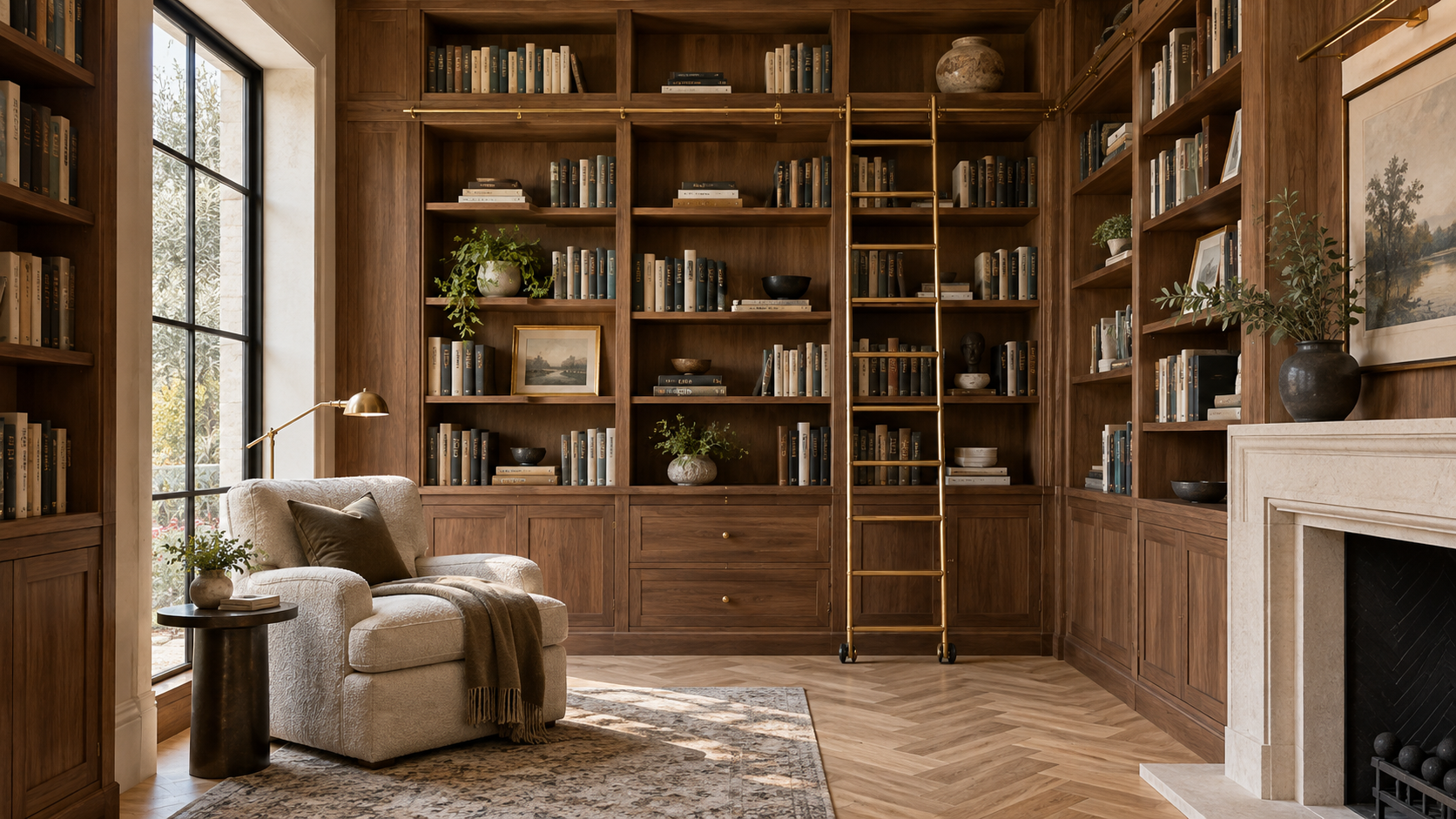
A home library works when it is planned around three things: shelving sized to the books you actually own, light that is kind to both paper and eyes, and one reading seat you will genuinely want to sit in. Get those right in the design phase and the room earns its square footage; skip them and it becomes a wall of décor nobody touches.
As homeowners move away from stark, showroom interiors toward warmer, more personal rooms, the library is coming back. We are seeing it requested far more often in early design briefs, sometimes as a full room and sometimes as a stair landing, a gallery wall, or a quiet corner off the primary suite.
Key Takeaways
- Size shelves to your collection: most hardcovers need 10–12 inches of depth and 11–13 inches of clear height.
- Keep direct sun off the shelves; north light or filtered east light is ideal for a reading room.
- Plan one great reading seat with its own lamp and power before you plan the shelving.
- Decide early whether the library is a room, a wall, or a passage — each needs different square footage.
Room, Wall, or Passage: Pick the Format First
The first design decision is not the shelving style. It is how much of the house the library gets. A dedicated room of roughly 12 by 14 feet holds a large collection plus a reading chair and a small table. A library wall in a living room or study holds a surprising amount in a fraction of the space. A library passage, shelves lining a wide upstairs hall or gallery, turns circulation space into storage that people see every day.
We ask clients to count their books, or at least estimate the linear feet of shelf they fill today, and add a third for growth. A typical shelf foot holds eight to twelve books. That single number usually decides the format for us.

Shelving That Fits the Books
Depth and height
Paperbacks sit comfortably on 8-inch-deep shelves; hardcovers want 10 to 12; art and coffee-table books need 14 or more and are best stored flat on a lower, deeper run. We usually make the bottom section of a wall deeper, with cabinet doors or drawers, and step back to shallower open shelves above. It reads as furniture, not a warehouse.
Span and sag
Books are heavy. A 36-inch shelf of hardcovers will visibly bow within a few years unless it is thick hardwood or reinforced with a hidden steel or face-frame edge. Keeping spans at 30 to 32 inches, or specifying a thicker nosing, is a detail that costs little on the drawings and saves a lot later.
Adjustability versus clean lines
Fixed shelves look crisper and stiffen the case; adjustable pins adapt to a changing collection. Our usual answer is fixed shelves at key alignment lines, with adjustable ones between them, so the elevation still looks composed.
Light: Protect the Pages, Help the Reader
Sunlight fades spines and yellows paper, so we avoid putting shelves where direct west or south sun falls on them. The reading seat, on the other hand, wants daylight. The best libraries separate the two: shelves on the walls that stay in shade, a window seat or chair near a north- or east-facing window.
After dark, three layers do the work: a dimmable ambient source, integrated LED strips or picture lights that wash the shelves without glare, and a dedicated task lamp at the chair. We place a floor outlet under the chair location in the drawings, so the lamp cord never crosses the room.

Comfort, Sound, and Climate
A library should be the quietest room in the house. Books themselves absorb sound well, but we still place the room away from the kitchen and media spaces, add solid-core doors, and favor a rug over hard flooring. In Houston's climate, stable humidity matters as much as quiet: paper and bindings do best around 40–50 percent relative humidity, which a well-sealed envelope and a properly sized HVAC system handle without a separate dehumidifier.
Finally, give the room one feature that makes it inviting to enter: a fireplace, a ceiling with some character, or a view to the garden. That is the difference between a library and a storage room with nice millwork.

If you are planning a custom home and want the library designed into it from the start, start a conversation with the studio.
FAQ
How big should a home library be?
A dedicated room around 12 by 14 feet holds a large collection and a reading chair comfortably. If space is tight, a single full-height library wall or a shelved upstairs hallway can hold several hundred books without adding a room.
How deep should built-in bookshelves be?
Plan 10 to 12 inches for most hardcovers and 8 inches for paperbacks. Oversized art books need 14 inches or more, so we usually make the lower section deeper and store them flat.
Where should a library go in the house?
Away from the kitchen and media room, on a wall that avoids direct afternoon sun. North or east light near the reading seat is ideal: bright for reading, gentle on the books.