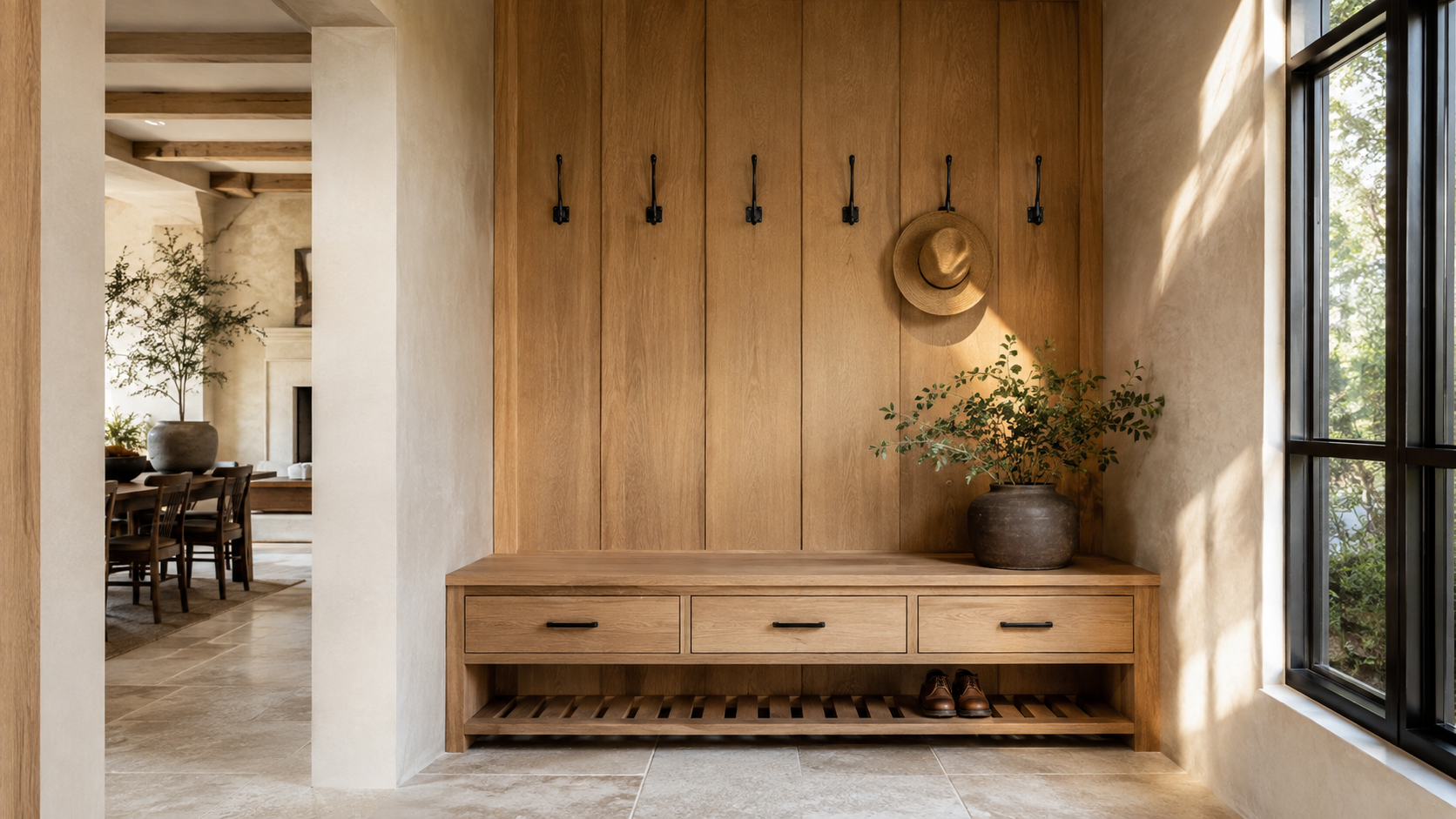
Custom millwork earns its cost wherever built-in joinery does a job furniture cannot: absorbing an awkward wall, hiding structure, holding a room's proportions, or turning dead depth into storage. Everywhere else, a good piece of furniture is cheaper, movable, and usually better looking. That single test — can furniture do this job? — settles most millwork decisions before a single drawing is made.
Millwork is also the line item clients underestimate most. It is not cabinetry alone. It is paneling, trim, stair parts, shelving, closet interiors, integrated seating, door casings and every piece of shop-built wood that arrives cut for one specific house. On a well-detailed home it can take a meaningful share of the interior budget, so we would rather spend it in four places properly than sprinkle it across twelve.
Key Takeaways
- Build in where the work is spatial or structural — entries, stairs, window seats, wall thickness. Buy furniture where the work is only storage.
- Millwork buys precision: an inch-perfect fit, continuous grain, no gap at the ceiling. That is what the premium pays for.
- Paint-grade poplar or MDF costs far less than stain-grade white oak or walnut, and in a busy room nobody reads the difference.
- Decide millwork during design, not after framing — appliance depths, outlet heights and lighting all depend on it.
- Overbuilt closets and garage cabinetry are where we most often see the budget wasted.
Where Built-Ins Are Almost Always Worth It
The entry
An entry has to hold coats, shoes, keys and mail without becoming a pile, and it usually has too little floor for a real furniture piece. A bench with drawers below and hooks above, built to the exact wall, is the difference between an entry that works and one everybody walks past on the way to dumping things on the kitchen island.

Stairs and the space under them
A staircase is millwork whether you plan it or not — treads, risers, stringers, handrail and balustrade are all shop work. Since the trades are already there, the volume underneath is the cheapest storage in the house. We routinely turn it into a pull-out pantry, a dog nook, a reading alcove, or full-height drawers on heavy-duty slides.
Kitchens, sculleries and anywhere appliances hide
Integrated refrigeration, panel-ready dishwashers and flush inset doors only look right when the casework is built to the appliance, to the millimetre. This is the room where the difference between semi-custom boxes and true joinery is visible from across the house: reveals stay even, doors line up, and the run reads as one built object rather than a row of purchased ones.

Libraries, offices and any wall you want to feel solid
Floor-to-ceiling shelving does something a bookcase cannot: it removes the gap at the top, so the wall reads as architecture instead of storage. That single detail — scribing the casework tight to the ceiling and returning the trim into it — is most of why built-in libraries feel expensive.
Where We Talk Clients Out of It
Closets are the biggest offender. A walk-in with drawer banks, hampers, jewellery trays and lit shoe shelves can cost more than a bathroom, and half of it sits behind a closed door serving clothes that change every few years. We build the fixed elements — hanging heights, shelving depth, an island if the room truly justifies one — and leave the rest to a specialist system later.
Guest rooms are the second. A guest room used two dozen nights a year does not need a built-in headboard wall. Dining rooms are the third: a beautiful sideboard you can take with you beats a built-in buffet nobody can reconfigure. And garage cabinetry, once you price it in real joinery, is almost always better bought as a modular metal system.
How to Control the Cost Without Losing the Look
Choose paint-grade where the eye is busy
Paint-grade poplar or a good MDF costs a fraction of stain-grade white oak or walnut. In a room full of texture — a kitchen with stone, a mudroom with tile — nobody reads the substrate. Save the visible-grain species for the two or three surfaces people actually touch and look at, and let everything else be painted.
Repeat one detail instead of inventing five
Millwork gets expensive through variety, not quantity. One door profile, one reveal dimension, one hardware family, one edge detail repeated across the whole house costs less to draw, less to shop-build and less to install — and it is also what makes a house feel designed rather than decorated.

Draw it before the walls go up
Millwork drawn after framing is millwork fighting the house. Outlets land in the middle of a backsplash, a window sits three inches into a planned run, and a bulkhead arrives where full-height doors were meant to go. We detail built-ins during design so framing, electrical and lighting are all set out to suit them. If you are weighing where to spend on a project, start a conversation with the studio before the drawings are frozen — that is when millwork money is worth the most.
Built-ins should look like the house grew them.
Frequently Asked Questions
How much does custom millwork cost in a luxury home?
It varies enormously with species, finish and complexity, so the useful way to think about it is per run rather than per house. Paint-grade built-ins are broadly comparable to good semi-custom cabinetry, while stain-grade hardwood with flush inset doors and matched grain can be several times that. Get shop pricing on two or three sample elevations early, then scale the rest of the house to it.
Is custom millwork better than semi-custom cabinetry?
Better at fit, not automatically better at quality. Semi-custom lines build excellent boxes. What they cannot do is fill a wall exactly, wrap an odd angle, meet a sloped ceiling, or carry one detail through several rooms. Where a room is regular and rectangular, semi-custom is often the smarter buy.
Does built-in joinery add resale value?
Built-ins that solve an obvious problem — entry storage, a working pantry, a genuinely useful office wall — read as quality to buyers. Highly personal ones, like a display wall built around a specific collection, read as something to rip out. Build the first kind if resale matters to you.
When in the design process should millwork be decided?
During design development, alongside the floor plan and well before permit drawings. Appliance selections, outlet locations, lighting layouts and even wall thicknesses depend on it, and every one of those is expensive to move later. You can see how that sequencing shows up in our built work — see our portfolio.