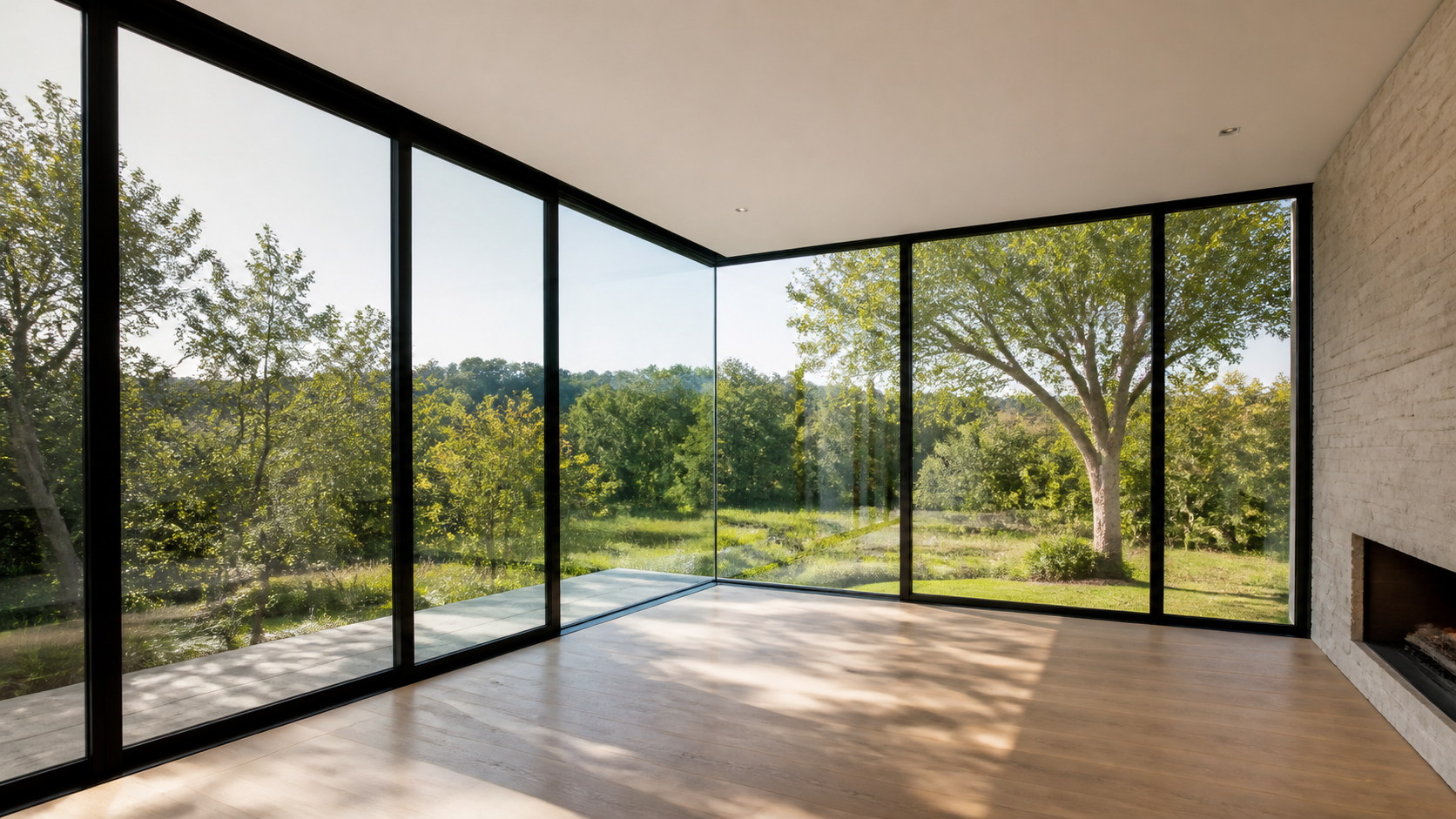
For most custom homes, the choice comes down to three families: thermally broken aluminum for large modern spans and thin sightlines, fiberglass for the best balance of performance and cost, and wood-clad for warmth inside with a weather-protected exterior. The frame decides how big the glass can get and how the house looks; the glass package decides how the house feels to live in.
Windows are usually the single largest line item in the envelope, and one of the few decisions that is genuinely permanent. We specify them early — during design development, not after pricing — because the frame you pick changes wall thickness, header sizes, and sometimes the structure behind the opening.
Key Takeaways
- Thermally broken aluminum gives the thinnest sightlines and the widest spans, at the highest cost per opening.
- Fiberglass moves at almost the same rate as glass, so seals last — it is the quiet value pick for most custom homes.
- Wood-clad delivers interior warmth, but the interior wood needs to be kept out of direct sun and splash zones.
- Vinyl is capable but rarely reads as luxury; we avoid it on primary elevations.
- The glass package — low-E coating, gas fill, and laminated layers — matters more for comfort than the frame does.
- In a hot, humid, storm-exposed climate, impact-rated glazing and a low solar heat gain coefficient are not upgrades. They are the baseline.
The Three Frame Families
Thermally broken aluminum
Aluminum is strong, so the frame can be slim and the glass can be huge — corner units, 12-foot lift-and-slide doors, floor-to-ceiling walls of glass. Raw aluminum conducts heat badly, which is why the thermal break matters: a polymer strut separates the inside and outside of the frame. Skip that detail and the frames sweat on humid mornings. This is the system we reach for when the architecture depends on the glass disappearing.

Fiberglass
Fiberglass frames are made from glass fibers, so they expand and contract at nearly the same rate as the glass they hold. That single fact is why fiberglass units tend to keep their seals for decades in a climate that swings from 40 to 100 degrees. Sightlines are thicker than aluminum and spans are smaller, but the thermal performance is excellent and the cost is meaningfully lower.
Wood-clad
A wood interior with an aluminum or fiberglass exterior skin gives you the best of both: real wood in the room, no exterior maintenance. It suits warm-modern, Hill Country, and transitional houses beautifully. The caution is placement — we keep interior wood out of unshaded west glass and away from shower and pool splash, where UV and moisture will find it first.
Vinyl deserves one honest line. It performs fine thermally and costs the least, but the frames are bulky, the color options are limited, and large units can bow in sustained heat. On a luxury custom home we generally reserve it for secondary or utility openings, if we use it at all.
The Glass Package Matters More Than People Expect
Two houses can use the identical frame and feel completely different, because the glass inside it is doing the real work. Three numbers drive that.
- Solar heat gain coefficient (SHGC): how much of the sun's heat gets through. Lower is better in a cooling-dominated climate; we typically target 0.25 or below on sun-exposed elevations.
- U-factor: how fast heat moves through the whole assembly. Lower is better, and it is where dual versus triple pane shows up.
- Visible transmittance: how much daylight comes through. Chase SHGC too aggressively and the glass starts to look gray and the view goes flat.
We also specify laminated glass more often than people expect — not only for impact zones, but because the interlayer cuts road noise noticeably and blocks nearly all UV, which protects rugs, art, and wood floors from fading.

Designing for a Hot, Humid, Storm-Exposed Climate
On the Gulf Coast the window schedule is a climate decision before it is an aesthetic one. Humidity punishes weak thermal breaks, the summer sun punishes west glass, and wind-borne debris requirements govern large openings across much of the Houston and Brazoria County area.
Shade the glass, then spec the glass
The cheapest glazing performance is the sun that never reaches the window. Deep overhangs, a wrapping porch, exterior louvers, or a well-placed live oak will outperform a coating upgrade every time. We size overhangs against the actual sun angles for the site, then let the glass handle what shade cannot.
Impact rating and where it applies
Windborne debris requirements vary by how close the site sits to the coast. Impact-rated laminated units are heavier and thicker, which affects frame selection and structural headers — another reason to settle glazing during design rather than at bid time. If you are weighing a coastal or near-coastal site, start a conversation with the studio before the plan is locked.

Frequently Asked Questions
How much should I budget for windows in a custom home?
As a planning range, windows and exterior doors commonly land between 8 and 15 percent of construction cost on a custom home. A glass-forward modern design with large aluminum spans can push past that; a traditional plan with modest punched openings sits below it.
Is triple pane worth it in Texas?
Usually not for energy alone. Our climate is cooling-dominated, so a good low-E coating and a low SHGC do more than a third pane. Triple pane earns its cost where noise is the problem — a busy road, a flight path, or a house very close to a neighbor.
When do windows need to be selected?
During design development, before construction documents are finished. Frame depth, unit weight, and impact rating all feed the structure and the wall assembly, so a late change ripples through the drawings.
Can I mix window brands or materials in one house?
Yes, and we often do — aluminum for the big public-facing spans, fiberglass for bedrooms and service areas. The rule is that anything visible from the same vantage point should match in color, sightline, and glass tint, or the elevation reads inconsistent.
Windows are where budget, comfort, and architecture meet. Get the frame family and glass package right early and the house stays quiet, cool, and true to the drawings for thirty years. To see how we handle glass on our own projects, see our portfolio.