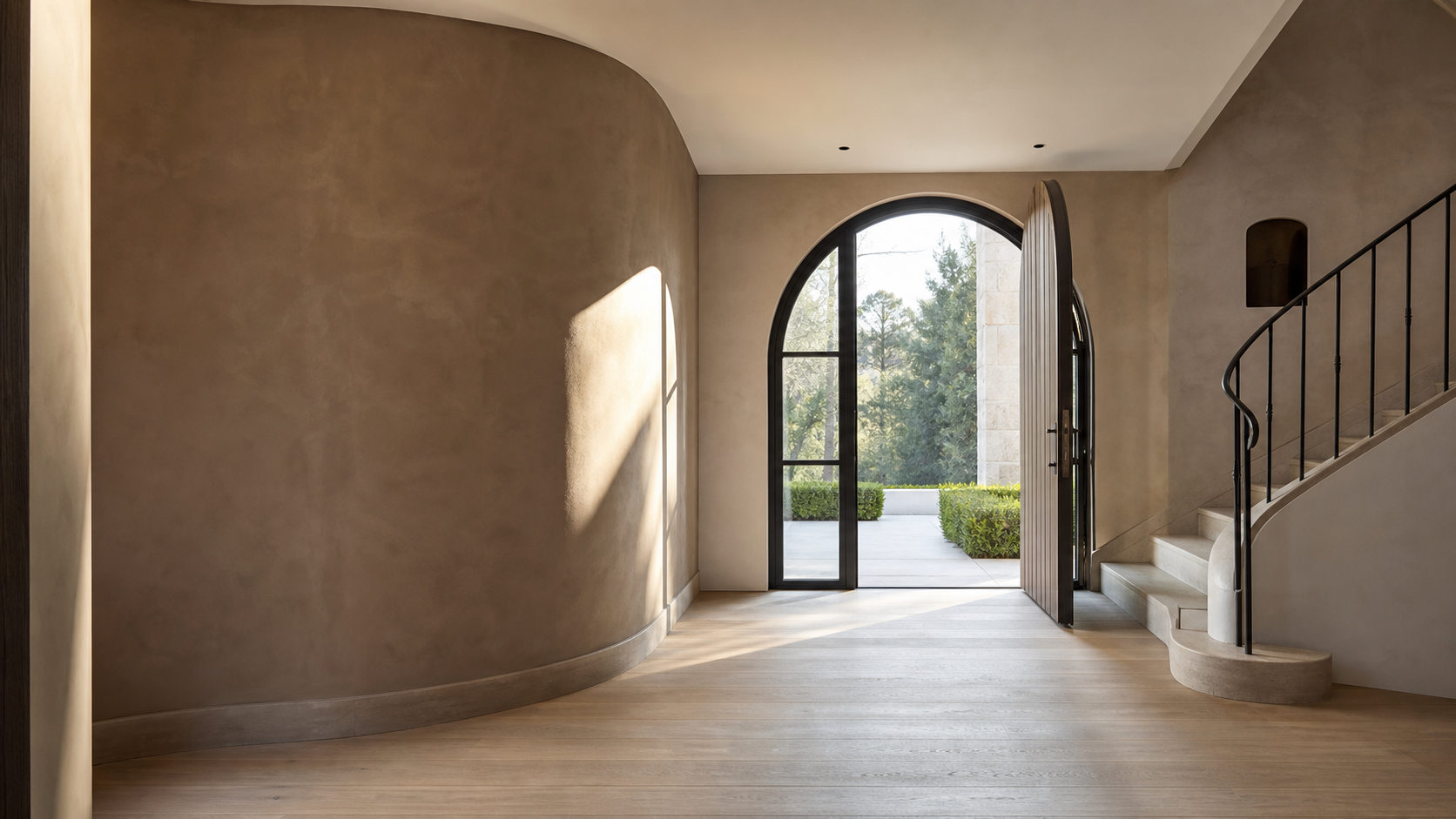
Curved architecture is the defining luxury custom home trend of 2026: arched openings, radiused hallways, vaulted niches, and sculptural staircases are replacing the sharp right angles that dominated the last decade. The reason is simple — curves make a home feel calmer, more crafted, and more human. Below is how we think about designing with curves so they read as timeless, not trendy.
Why the hard-edged modern home softened
The minimalist boxes of the 2010s prized crisp corners and flat planes. In 2026, luxury clients want warmth and movement instead. A curve draws the eye through a space rather than stopping it at a corner, and it catches light gradually, giving walls a soft gradient that flat drywall never achieves. The result feels quieter — the same reason a rounded pebble feels better in the hand than a cut brick.
Where curves earn their place
Curves are most powerful when they mark a moment: an entry, a transition, or a place you pause. Used everywhere, they lose meaning and cost a fortune. We concentrate them where the payoff is highest.
- Entry sequences — an arched front door or a curved foyer wall sets the tone before anyone reaches the living space.
- Circulation — a radiused hallway or a spiral of stair softens the journey between rooms.
- Ceilings — barrel vaults and coved edges add volume without extra square footage.
- Openings — arched cased openings between rooms feel more generous than a standard rectangular doorway.

Materials that make a curve look intentional
A curve is only as good as its finish. Hand-troweled lime plaster is the material of the moment because it wraps a radius seamlessly and reads as a single sculpted surface. Continuous handrails in blackened steel or bronze trace a stair without visible joints. And warm, tactile finishes — boucle, linen, rough stone — keep curved rooms from feeling cold or clinical.

The engineering behind a good curve
Curves are a design decision and a construction one. A true radiused wall requires flexible track, tighter stud spacing, and a plasterer who can float a smooth arc — not something a standard framing crew hits by accident. Barrel-vault ceilings need coordination with structure and mechanical runs early, before ductwork claims the space a vault wants. Designing the curve on paper and in the field at the same time is what separates a graceful arc from a lumpy one.
Are curved walls more expensive to build?
Yes — a curved wall typically costs more than a straight one because of the specialized framing and the extra plaster labor. That is exactly why we place curves selectively. A few well-chosen arches deliver most of the emotional impact at a fraction of the cost of curving everything.
Will curved architecture date quickly?
Arches and vaults are some of the oldest forms in building, so the geometry itself is timeless. What dates a home is chasing a specific styling — loud colors or gimmicky shapes. Keep the curves architectural and the palette warm and neutral, and the look ages well.
Can you add curves to a home that's already designed?
Sometimes. Arched cased openings, coved ceiling edges, and a curved plaster feature wall can often be introduced without touching the structure. Full radiused exterior walls are far harder to retrofit and are best decided at the design stage.
Designing curves that last
The homes that will still feel fresh in a decade use curves with restraint: one memorable arch at the entry, a soft stair, a vaulted ceiling over the room where people gather. If you're planning a custom home and want softened, sculptural geometry that still feels grounded, start a conversation with the studio or see our portfolio to explore what's possible on your site.