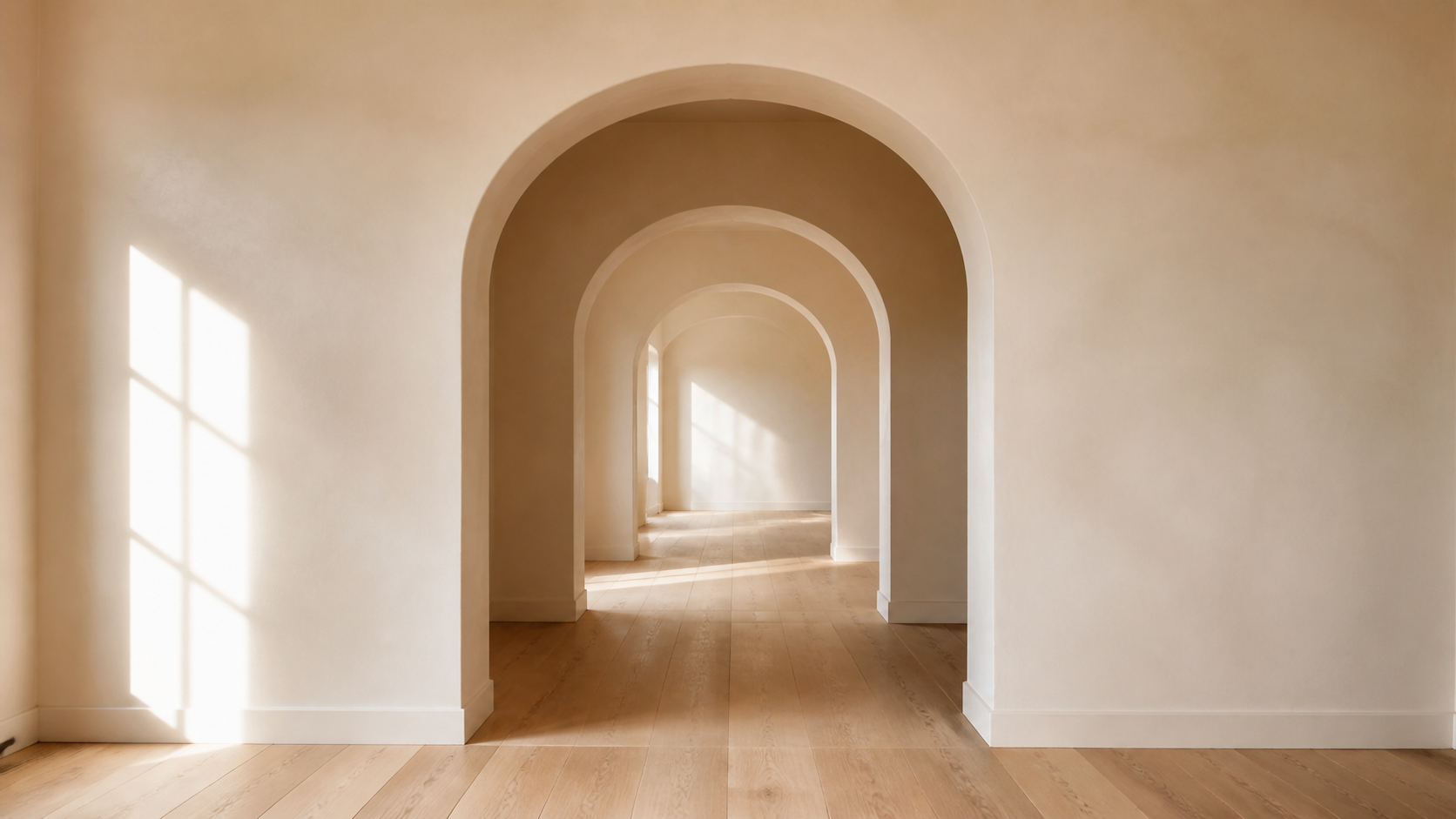
A curve looks timeless when it is doing a job — carrying a load, turning a corner, guiding you toward a view — and looks like a fad when it is stuck onto a flat wall for decoration. That single test is how we decide, on every project, whether an arch belongs. Get it right and a curved doorway reads as architecture a hundred years from now. Get it wrong and it dates faster than a paint colour.
Key Takeaways
- Curves earn their place when they follow structure, circulation, or light — not when they are applied as ornament.
- Use one curve language per house. Mixing sharp Roman arches with soft plaster bullnoses reads as indecision.
- The radius matters more than the shape. Tight, tense curves look cheap; generous, slow curves look built.
- Plaster and stucco hold a curve better than drywall, which is why the best examples are almost always mineral-finished.
- Budget for the trades, not the geometry. A curved opening costs what it costs because of framing, finishing and glass, not the drawing.
What Curved Architecture Actually Means
The current wave covers four distinct moves that get lumped together: arched openings between rooms, rounded wall returns where two planes meet, vaulted or barrel ceilings, and curved built-in elements like a plaster range hood or a radiused island. They come from different traditions and they do not automatically belong in the same house.
Arches are structural in origin. Before steel headers, an arch was how you spanned an opening in masonry. That history is why a well-proportioned arch still reads as solid and permanent — the eye recognises a shape that is holding something up, even when a modern build is really spanning with an engineered beam behind the plaster.

Where a Curve Earns Its Place
At a transition between two kinds of space
An arched opening is a threshold marker. It tells you that you are leaving one room and entering another with a different purpose — kitchen to dining, hall to stair. If the two spaces on either side are essentially the same, the arch has nothing to announce and it will feel arbitrary.
Where movement wants to turn
Rounded returns and curved wall ends work hardest at points where people actually change direction: the base of a stair, the pivot into a scullery, the end of a corridor. The curve follows the path a body already takes, which is why it feels inevitable rather than styled.
Where light needs to be softened
A barrel-vaulted ceiling or a coved wall junction has no hard shadow line, so daylight wraps rather than breaks. In a room with one strong window, that alone changes the quality of the light — the difference between a bright room and a luminous one.

The Details That Separate Timeless From Trendy
Almost every curve that ages badly fails on proportion rather than concept. A springline set too low turns an arch into a tunnel. A radius that is too tight makes a rounded corner look like a manufacturing accident. As a rule of thumb, we start an arch at least seven feet above the floor and let the curve be slow — a segmental arch across a wide opening usually beats a full semicircle, which can feel cartoonish once the span exceeds four feet.
The second failure is material. A curve formed in drywall relies on a corner bead and joint compound, and every seasonal movement shows up along that line. Formed in plaster, lime or a hand-troweled mineral finish, the curve is continuous with the wall and there is no seam to crack. That is why the images homeowners save from Europe almost always turn out to be plaster: the finish is doing half the work.
The third is consistency. Pick one curve language and stay in it. If the openings are segmental, the niches should be segmental. If the wall returns are soft bullnoses, the shower niche should not suddenly be a sharp Roman half-circle. Coherence is what makes a house look designed instead of decorated.

What Curves Actually Cost
The drawing is free; the trades are not. A curved opening adds framing labour, custom-cut jambs, more finishing hours, and — if there is glass involved — genuinely expensive fabrication, because a radiused window or a curved shower enclosure is a bespoke item with no shelf equivalent. A barrel vault adds engineering coordination and skilled plaster hours on top.
The honest planning advice is to concentrate the budget. Three well-executed curves in the places the house actually turns will outperform fifteen arched openings finished quickly. In our experience the arch you regret is never the one you left out — it is the one that was value-engineered halfway.
Curves in a Humid Gulf Coast Climate
There is a local wrinkle worth naming. The Houston humidity swing is hard on any assembly that depends on a joint staying still, which is exactly the weakness of a drywall-and-bead curve. Mineral plasters are vapour-open and move with the wall, so they hold a curved profile far better here than a taped edge does.
Outside, the same logic applies to a curved stucco parapet or an arched loggia opening: detail the drainage and the drip edge properly, because a curve sheds water sideways, not straight down. It is a small thing that separates a five-year facade from a thirty-year one.

Frequently Asked Questions
Are arches going out of style?
Arched openings that follow structure and circulation have been in continuous use for two thousand years and will not date. What dates is the applied version — a shallow arch cut into a partition wall purely as a look. If the curve has a reason, it stays.
Can you add arches to an existing house?
Sometimes. Non-load-bearing partitions are straightforward. Anything in a bearing wall needs a header and an engineer, and the retrofit is usually only worth it where the new opening also improves how the house is used — widening a pinched hall, for example.
Do curved walls make a room feel smaller?
The opposite, generally. Softening the corners removes the hard stop your eye reads as an edge, so the room feels like it continues. The exception is a tight radius in a small room, which crowds the space and eats usable floor area.
What curve is best for a wide opening?
A segmental arch — a shallow slice of a much larger circle. It keeps a generous head height across the span and avoids the heavy, tunnel-like feeling a full semicircle creates once the opening is wider than about four feet.
Curves are one of the few moves that change how a house feels before anyone can say why. We plan them early, alongside structure and light, rather than adding them at finish stage — if you are weighing them for your own project, start a conversation with the studio and we will show you where they would earn their keep.