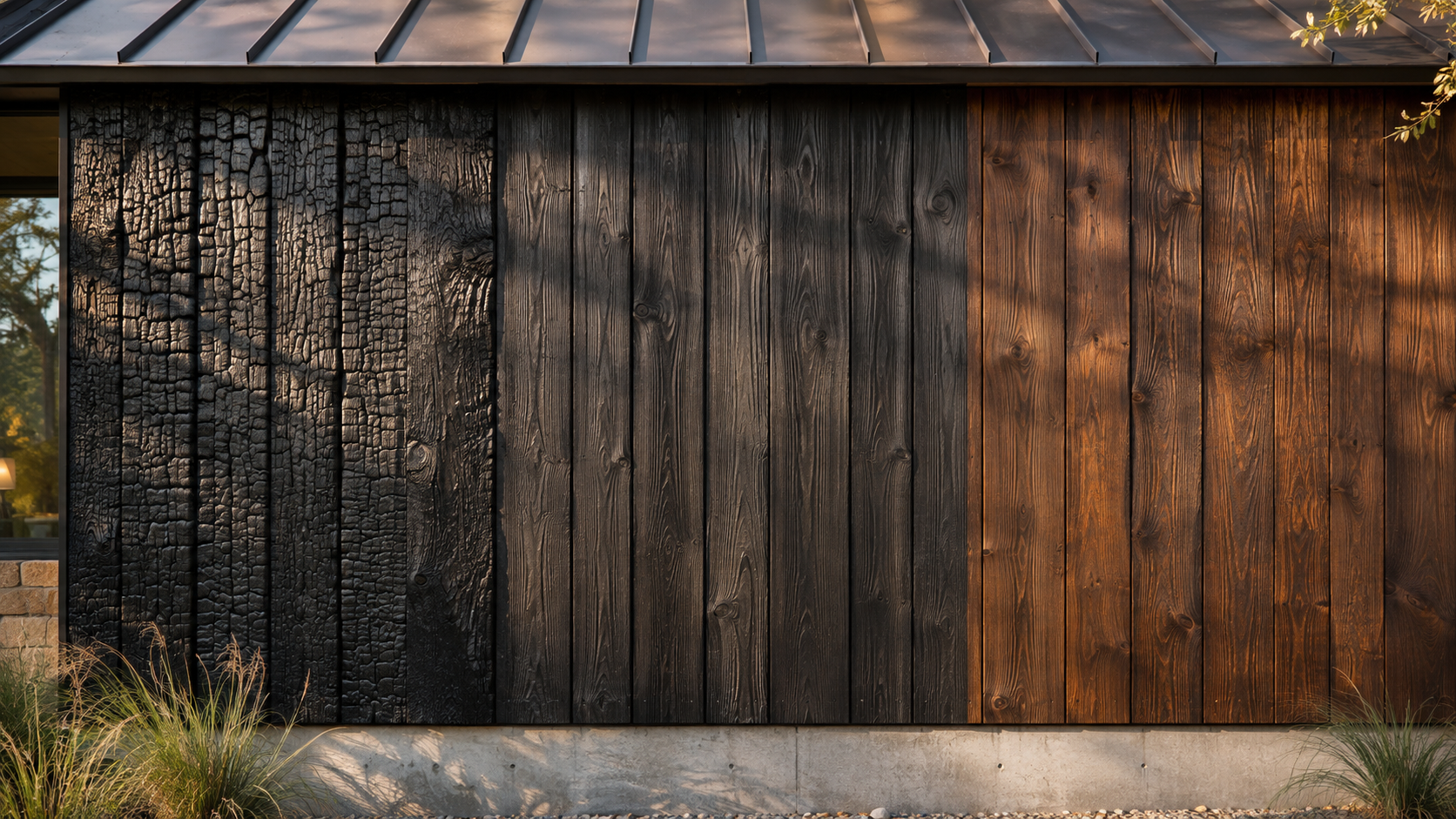
Charred wood siding, also called shou sugi ban or yakisugi, is worth it on a custom home when you want a deep, matte, natural facade and accept light, regular care. The burnt surface slows weathering, but in a humid climate the siding lasts only as long as the wall behind it can drain and dry.
As experts in home design, we get asked about charred wood more than almost any other cladding right now. Homeowners see it on modern farmhouses, Hill Country retreats and dark, quiet-luxury exteriors, and want to know if it is a real material or a trend that will look tired in five years. Here is how we think about it.
Key Takeaways
- Shou sugi ban is wood (usually cypress, cedar or pine) whose surface is burned, cooled, brushed and usually oiled.
- The char layer slows UV damage and surface wear, but independent testing has not shown it reliably makes wood rot-proof or fireproof.
- Finish level matters: heavy 'alligator' char is rugged but sheds soot; brushed and oiled finishes are cleaner and easier to live with.
- In humid climates, a ventilated rainscreen gap behind the boards is the single detail that decides how long the siding lasts.
- Plan for re-oiling every few years on sun- and rain-exposed walls, and use it where the eye and the hand meet it, not on every elevation.
What Charred Wood Siding Actually Is
The traditional Japanese method burns the face of a board until a crust of carbon forms, then cools it. Modern producers do the same with torches or kilns, then brush away some or all of the loose char and finish the boards with a penetrating oil. The result ranges from glossy cracked black to a soft, grained charcoal to a brushed brown that shows the wood beneath.
Species matters. Japanese cedar (sugi) is the classic choice, while cypress, Western red cedar, larch and even pine are common in the U.S. A denser, more decay-resistant species gives the char a better base to work from.

What the Char Does, and What It Does Not
The real benefits
The carbon layer shields the wood from sunlight, which is what grays and erodes untreated siding. It also gives the facade a rich, even color that hides small dents and grain variation, and it ages gracefully rather than flaking like paint. Many owners like that it reads as natural rather than manufactured.
The honest limits
Marketing claims run ahead of the evidence. A USDA Forest Products Laboratory study of commercial charred siding found the process did not consistently improve durability or flammability, and results varied by species and treatment. We treat charred wood as a beautiful, long-lived wood siding, not as a fire-rated or rot-proof one. If your site has wildfire or fire-separation requirements, those are met by the wall assembly, not by the char.
Charred Wood in a Humid Climate
Here in the Houston area, the challenge is not cold or sun alone; it is water that lingers. Wind-driven rain, long humid stretches and heavy dew mean wood siding stays damp longer than it does out West. Vendors themselves list humid subtropical and coastal climates as the hardest on wood cladding, and mildew on shaded walls is common.
That is why our design experts detail charred wood the same way we detail any wood siding in a hot-humid climate:
- Ventilated rainscreen: furring strips (about 3/4" deep) behind the boards create an open, drained air gap, with insect screen and a drip flashing at the base. Corner boards and window casings are drawn to allow for that extra depth.
- Clearance from grade: boards stop at least 6" above finished soil and well above splash zones at patios and roof-to-wall joints.
- Sealed ends and faces: every cut end and the back face are sealed before installation, so water does not wick into the grain.
- Stainless fasteners: stainless steel screws or nails resist staining and loosening as the wood swells and shrinks.
- Deep overhangs: a generous roof overhang does more for charred wood than any finish, keeping rain and midday sun off the wall.
Behind the rainscreen, the wall itself has to be allowed to dry outward and inward. For more on why a cold-climate vapor barrier is the wrong move here, see why vapor barriers from colder climates trap moisture in Houston walls.

Choosing a Finish and Where to Use It
Heavy, unbrushed char looks dramatic but leaves black dust on hands and clothing, so we keep it to high or out-of-reach walls. Brushed and oiled boards are the practical choice near entries, porches and pool decks, where people lean, brush past or hose things down.
We also rarely clad an entire house in it. Charred wood is strongest as one material in a composition: a dark wing against brick or limestone, a garage volume, a recessed entry or a wall framed by a deep porch. Used this way it adds warmth and depth without making the house feel heavy. See our portfolio for how we balance materials on a facade.

Maintenance and Cost
Plan to inspect charred siding every year or two and re-oil sun- and rain-exposed walls every few years; sheltered walls can go much longer. Check shaded faces for mildew and re-tighten any fasteners that have backed out. Left alone, the boards slowly fade to a silvery charcoal, which some owners prefer.
Charred wood typically costs more than fiber cement and painted wood siding and is closer to premium cedar or stone veneer once the rainscreen and stainless fasteners are counted. It is a material to spend on where it shows most.
FAQ
How long does shou sugi ban siding last?
Well detailed and maintained, it can outlast most painted wood siding by decades. Claims of 80 to 100 years come from Japan's climate and vendors, so in humid Texas we plan around regular re-oiling instead.
Is charred wood siding fireproof?
No. Independent testing has not shown that charring reliably improves fire performance. Fire requirements are met by the full wall assembly, which we design as part of the expert guidance on any project.
Does charred wood rub off?
Heavy, unbrushed char does leave soot on hands. Brushed and oiled finishes barely mark, which is why we use them where people touch the wall.
If you are weighing charred wood against brick, stucco or stone for your facade, our residential design expertise can help you find the right balance for your site and climate. Start a conversation with the studio.