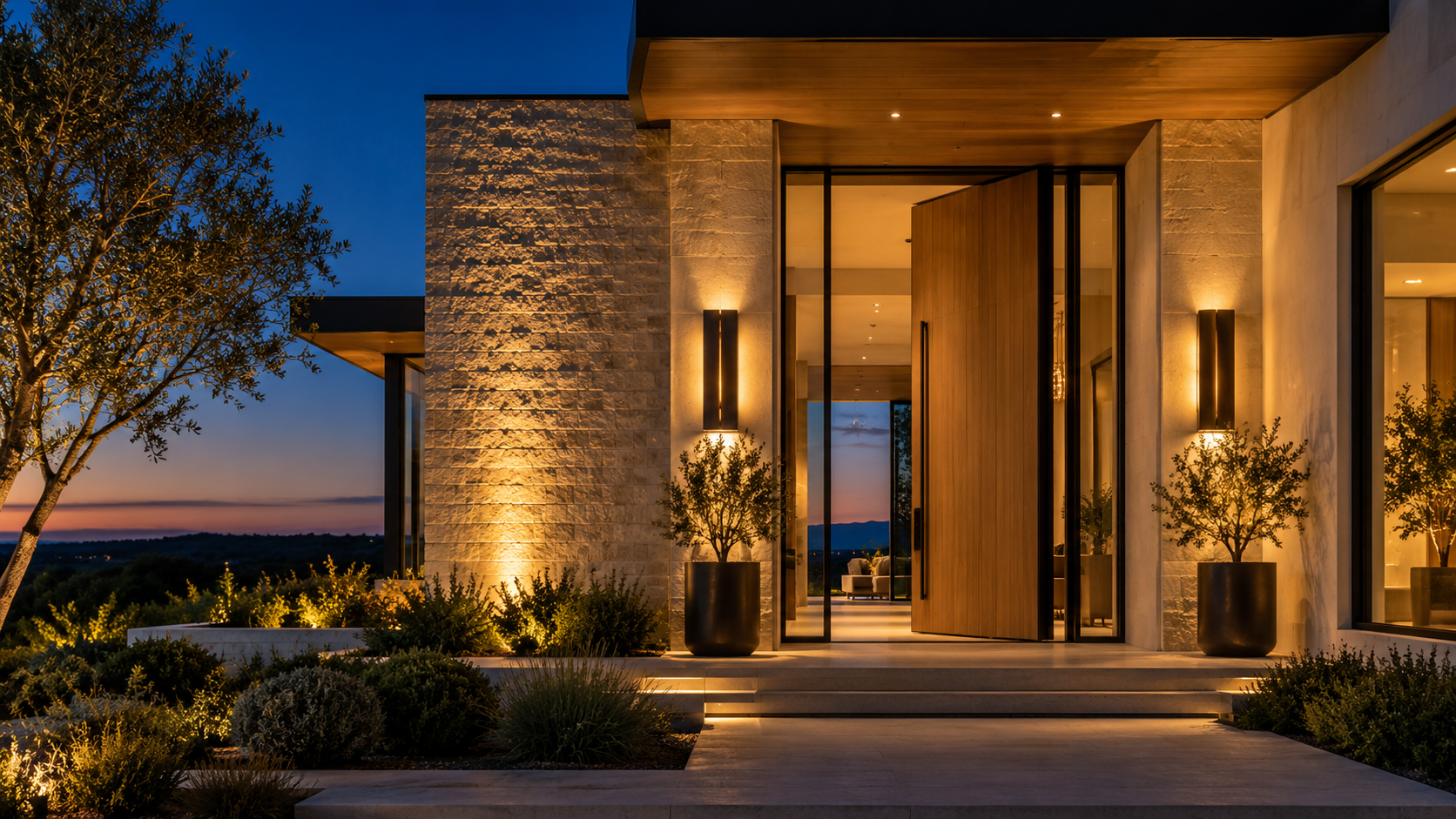
Good exterior lighting design lights a house with fewer fixtures than most people expect: warm, shielded light that washes the facade, marks paths and steps, and picks out one or two trees, with the rest left dark on purpose. The best results come when the exterior lighting is planned alongside the house itself, not added once the landscaping is in.
As experts in home design, we see the same pattern on finished houses: bright floodlights at the garage, a row of identical path lights along the walk, and a facade that disappears after sunset. Here is how we approach landscape and facade lighting instead.
Key Takeaways
- Light surfaces, not the sky. Shielded fixtures aimed at walls, trees and paths look better and keep glare out of eyes and neighbors' windows.
- Use warm color temperature outside, around 2700K, and dim it lower than you think. Contrast does more than brightness.
- Light where people walk, step and arrive first: the front door, steps, driveway edges and the back terrace.
- Pick one or two hero elements, usually a specimen tree and the entry, rather than lighting everything evenly.
- Plan conduit, transformer locations and switching during design, before slabs, hardscape and planting are poured or set.
Start With the Facade
A house reads at night by its walls. A soft wash of light grazing a stone or brick surface shows texture the way low evening sun does, while flat light from a single fixture flattens it. We usually place a small number of in-grade or ground-mounted fixtures close to the base of key walls and columns, angled up so the light fades as it rises.
Wall sconces at the front door do a different job: they welcome and identify the entry. Size them generously, often a third to a quarter of the door's height, and choose fixtures that hide the bulb so you see the glow, not the source.

Paths, Steps, and the Arrival Sequence
Path lighting is about safety first and atmosphere second. The goal is to see the edge of the walk and every change in level, not to line the path like a runway. Staggering low fixtures on alternating sides, or tucking step lights into the risers and adjacent walls, gives even coverage without the airport effect.
Where to put the light
- Every step and landing, ideally with lights recessed into risers or side walls.
- The edges of the driveway and motor court, kept low so headlights do the long-range work.
- Gate and mailbox locations, so guests and deliveries find the way in.
- Transitions from the house to the terrace, pool deck and garden.

Landscape Lighting: Trees, Gardens, and Water
One well-lit tree can carry an entire yard. A mature live oak uplit from two or three positions becomes a sculpture at night, and its canopy can even moonlight the lawn below when fixtures are mounted high in the branches, pointed down. Lighting every shrub, by contrast, makes a garden look busy and flat.
Big trees also change how wiring gets run. Trenching through a root zone can harm the tree, so we route low-voltage lines around the canopy edge or bore under it. If you are deciding whether a large tree near the house should stay, this guide on what to do about a live oak growing close to the house is worth reading before the site plan is fixed.

Color, Brightness, and Dark Skies
Outside, less light looks better. Warm white around 2700K flatters stone, wood and plants, while cooler light reads as commercial. Low output with good shielding creates depth, because the eye needs darkness to notice what you chose to light.
Shielded, downward-aimed fixtures also respect dark-sky principles: less glare, less light spilling into neighbors' bedrooms, and less confusion for wildlife. In our residential design expertise, the houses that feel most luxurious at night are rarely the brightest on the street.
What Changes in Houston and the Gulf Coast
Heat, humidity and storms are hard on outdoor fixtures. We favor solid brass, bronze or marine-grade materials over painted aluminum, sealed fixtures rated for wet locations, and in-grade lights with drainage beneath so they do not sit in water after a Gulf storm. Closer to the coast, salt air makes material choice even more important.
Bugs are drawn to cooler, bluer light, so warm color temperature has a practical benefit on terraces and porches too. And because power outages happen here, it helps to decide early which exterior circuits, such as the entry and steps, should run on a generator or battery.
Plan It With the House
Exterior lighting is cheapest and cleanest when it is designed before construction. Conduit under the driveway, sleeves through walls, blocking for sconces, transformer locations hidden from view, and controls that group lights into scenes all depend on decisions made during design. Our design experts coordinate these with the electrical plan so the landscape installer has a path to follow.

Frequently Asked Questions
What color temperature is best for exterior lighting?
Around 2700K for most homes. It looks warm and natural on stone, brick, wood and plants, and it draws fewer insects than cooler light. Some designers go as low as 2200K for a candlelit feel on terraces.
Should landscape lighting be low voltage or line voltage?
Most landscape lighting is low voltage. It is safer, easier to adjust as plants grow, and works well with LED fixtures. Line voltage still makes sense for wall sconces on the house and some high-output fixtures.
When should exterior lighting be planned?
During design, alongside the electrical plan. Conduit under paving, wall sleeves and transformer locations are easy to include early and expensive to add later.
How many fixtures does a house need?
Fewer than most people expect. Light the entry, steps, paths, one or two trees and the main outdoor living space first, then add only where something is missing. If you want expert guidance on lighting your own house, start a conversation with the studio.